

We are entering an AI infrastructure supercycle, a structural shift that will redefine enterprise strategy for the next decade.
This is not another wave of software adoption. It is a broader industrial and digital revolution centered on the physical foundations of AI:
- Compute
- Power
- Land
- Cooling
- Networking
- Orchestration
What makes this moment so consequential is that it represents more than incremental technology progress.
Supercycles reorder capital, compress decision timelines, reshape competitive advantage, and reward the organizations that recognize the shift early. In this case, the revolution is being driven by the realization that AI at scale depends not only on algorithms, but on the ability to secure and scale the infrastructure beneath them.
This is why the AI infrastructure supercycle is a leadership issue. CIOs, CTOs, CFOs, and boards can no longer treat architecture, procurement, capital planning, and risk as separate conversations.
In the supercycle era, infrastructure strategy becomes business strategy, capital strategy, and competitive strategy all at once.
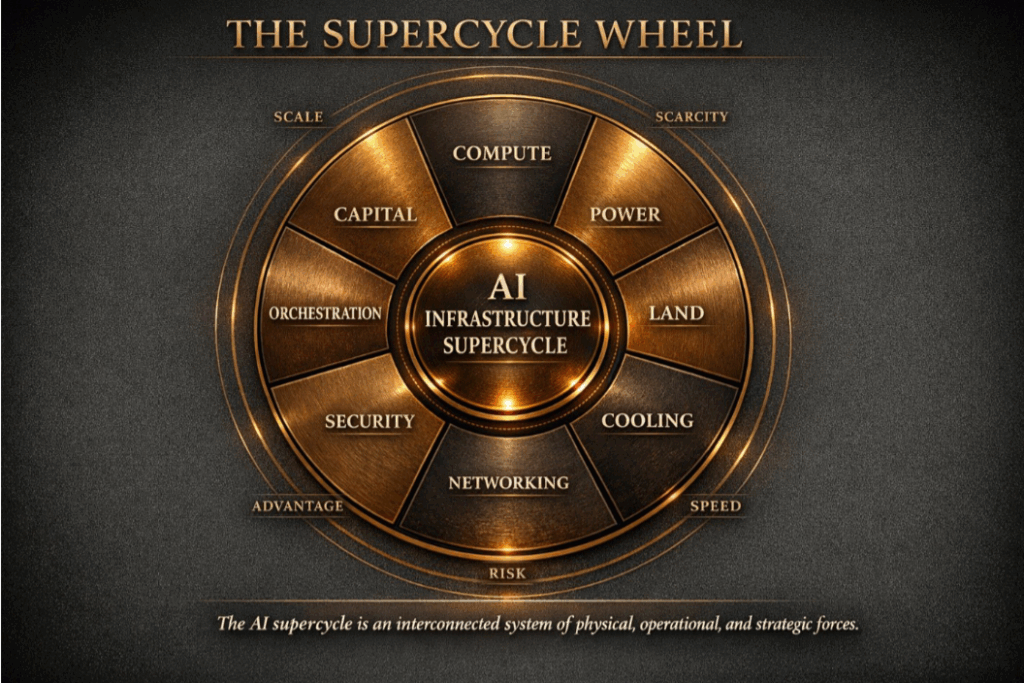
Figure 1 frames the AI infrastructure supercycle as an integrated strategic system shaping enterprise advantage.
I chose this opening graphic because the AI infrastructure supercycle is best understood as an interconnected system rather than a series of isolated technology trends. The wheel format reinforces that compute, power, land, cooling, networking, security, orchestration, and capital now move together as a single strategic architecture. That is the core shift leaders need to see clearly.
Capital Allocation in the AI Infrastructure Supercycle
Seen through that lens, the next question is where capital will concentrate and why.
The answer is not limited to chips. It spans the full stack of infrastructure that will determine which enterprises can build, scale, and govern AI with durability.
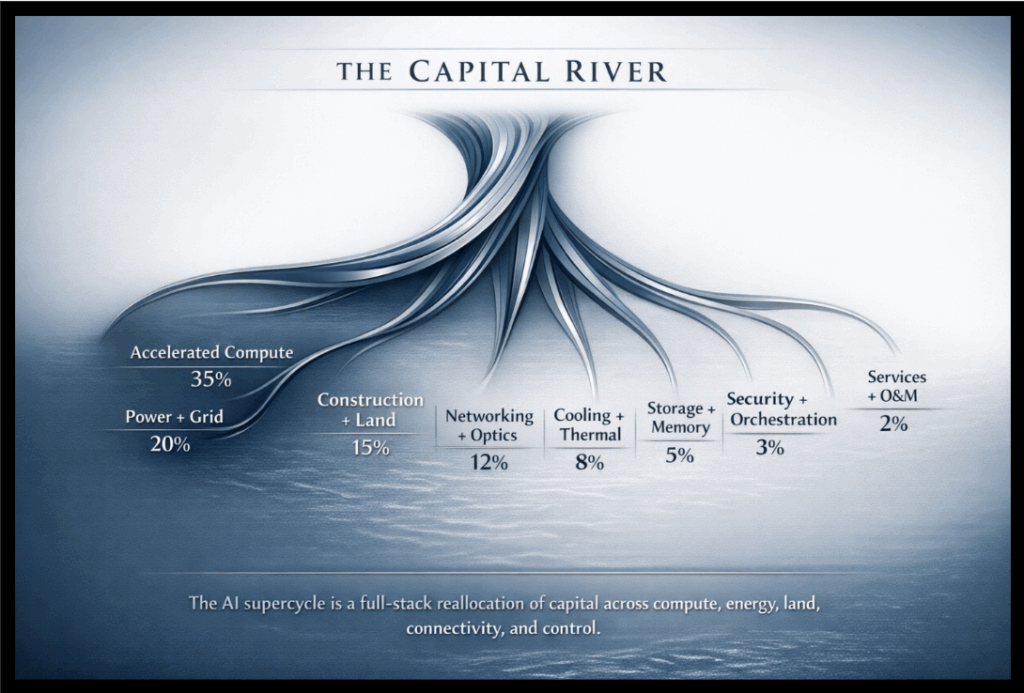
Figure 2 highlights how the supercycle is redistributing capital across the full AI infrastructure stack.
I chose this second graphic to make one point unmistakable: this is not just a compute story.
The capital river shows how the supercycle redistributes investment across the full infrastructure stack, from accelerated compute and grid access to land, cooling, memory, and orchestration. It is meant to help readers see the scale of the reallocation and why leadership teams need a full-stack view of AI investment.
The dollar amounts below should be read as directional allocation estimates within an approximately $7 trillion AI data center and infrastructure buildout through 2030, drawing on recent industry analysis rather than precise line-item forecasts.
Their value is strategic. They indicate where capital intensity is likely to concentrate as the supercycle unfolds and where enterprise leaders should expect the greatest pressure, competition, and opportunity.
Accelerated Compute — $2.45T (35%)
The largest share of supercycle investment will continue to flow into GPUs, AI accelerators, advanced packaging, and memory bandwidth.
In a true infrastructure supercycle, the strategic issue is not simply access to compute, but the ability to secure it with enough durability to support long-horizon planning and sustained competitive execution. Multi-year allocation strategies, vendor diversification, and architectural heterogeneity will become defining features of this cycle rather than optional safeguards.
Power + Grid — $1.40T (20%)
Power and grid access are emerging as the defining bottlenecks of the AI infrastructure supercycle.
As infrastructure requirements expand well beyond traditional data center assumptions, energy strategy moves out of the facilities function and into the center of enterprise planning. In supercycles, control points matter disproportionately, and the organizations that treat power procurement, grid interconnection, and capacity forecasting as strategic disciplines will build a significant structural advantage.
Construction + Land — $1.05T (15%)
Construction capacity, permitting timelines, zoning complexity, and land availability will shape how quickly AI infrastructure can be deployed during this supercycle. The right location is a strategic lever that determines speed, resilience, and expansion capacity.
Large AI data centers are also facing growing community backlash over power demand, water use, noise, traffic, and land use, turning local approval into a strategic variable.
As with every major capital supercycle, advantaged positions will accrue to those who secure scarce physical assets early and build the support required to deploy them.
Networking + Optics — $0.84T (12%)
Networking and optics are no longer secondary to compute in the AI infrastructure supercycle. High-bandwidth, low-latency interconnects increasingly determine how efficiently models can train, scale, and perform in production.
This is one of the most underappreciated supercycle dynamics: interconnect architecture is becoming a direct contributor to model quality, utilization, and overall economic efficiency, which means capital will increasingly follow bandwidth as well as compute.

Cooling + Thermal — $0.56T (8%)
Cooling and thermal design are moving to the center of the equation as AI workloads drive densities that conventional environments cannot support efficiently.
This is one of the clearest expressions of the supercycle revolution: infrastructure has become inseparable from performance.
Liquid cooling, immersion approaches, and advanced thermal engineering are becoming core capabilities for organizations that intend to operate at scale throughout the cycle, consistent with current analysis on AI data center power density and thermal management.
Storage + Memory — $0.35T (5%)
Storage and memory architecture will matter far more than many enterprise leaders currently assume in this supercycle. High-bandwidth memory, flash, and distributed storage pipelines underpin both training and inference performance, and they influence cost just as much as speed. Memory bandwidth is now a first-order architectural and economic decision that will separate the enterprises that can scale efficiently from those that cannot.
Security + Orchestration — $0.21T (3%)
Security and orchestration will become more important as AI environments grow more distributed, API-driven, and operationally complex across the supercycle. Zero-trust design, workload isolation, and AI-aware threat detection will need to be built into the infrastructure layer itself.
In a supercycle, trust, resilience, and control become strategic differentiators, and AI infrastructure increasingly becomes the system through which those differentiators are expressed.
Services + O&M — $0.14T (2%)
Services, integration, and ongoing operations may represent a smaller share of capital, but they will play an outsized role in long-term success throughout the supercycle.
AI infrastructure is an operating model that requires continuous tuning, lifecycle management, and cross-functional coordination. The organizations that understand this early will be better positioned not only to absorb capital efficiently, but to convert the supercycle into durable operating advantage over time.
Executive Implications of the AI Infrastructure Supercycle
Taken together, these visuals frame the leadership challenge clearly. The wheel shows the system. The capital river shows how investment is moving through that system.
The executive question, then, is how to convert that understanding into decisions on power, architecture, procurement, engineering, and risk.
- Power Becomes a Primary Strategic Constraint: The first implication of the AI infrastructure supercycle is that power may become the hardest constraint in the entire roadmap. In practical terms, infrastructure planning will need to account for long-term power purchase agreements, on-site generation options, grid-interconnection timelines, and detailed thermal modeling much earlier than most technology organizations are accustomed to. In this supercycle, power becomes what cloud region selection once was: a foundational strategic choice that shapes speed, deployment flexibility, and long-term competitive capacity.
- Hybrid AI Architecture Becomes the Operating Model: A second implication of the supercycle is that hybrid AI architecture will become the default operating model for most enterprises. Few organizations will rely on a single environment when they need to balance performance, sovereignty, regulation, latency, and cost. The more likely pattern is a portfolio approach that blends hyperscale GPU clouds, on-premises AI clusters, sovereign zones, edge inference capacity, and an emerging class of neoclouds designed for AI-intensive workloads. In that context, a unified orchestration layer matters more than allegiance to any single vendor stack.
- Procurement Shifts to Long-Horizon Capacity Strategy: Procurement strategy will also need to evolve under supercycle conditions. As GPU allocation, optics, and power equipment remain supply constrained, short-cycle sourcing models will prove inadequate. CIOs and CTOs should plan around multi-year commitments, vendor diversification, capacity reservations, deeper partnerships, and selective use of neocloud providers where they create speed or flexibility advantages. In a supercycle, procurement becomes a strategic capacity discipline rather than a transactional function.
- Infrastructure Engineering Moves to the Strategic Core: Another major supercycle implication is that infrastructure engineering moves to the strategic core. Cooling, power, and networking are no longer secondary operational issues or isolated facilities concerns, they are increasingly direct determinants of AI performance, cost efficiency, and deployment speed. In other words, as this supercycle unfolds, infrastructure engineering becomes a frontline capability for competitive execution rather than a background support function.
- AI Infrastructure Emerges as a Board-Level Risk Domain: Finally, the AI infrastructure supercycle elevates infrastructure to a board-level risk domain. Boards will increasingly expect management teams to articulate the opportunity as well as the exposure: power availability, model-training economics, vendor concentration, cyber posture, regulatory risk, and rising local resistance to large-scale AI infrastructure. In a supercycle, these exposures compound quickly and can materially affect capital efficiency, execution speed, and resilience. Leadership teams that frame them clearly and early will be in a much stronger position to secure support for long-term AI investment.
Strategic Priorities for Leading Through the Supercycle
My central takeaway is this: the AI infrastructure supercycle is not a background trend, it is the new strategic context in which AI decisions will be made.
Enterprises that plan only for models and use cases will be caught off guard by the realities of power, cooling, procurement, land, and deployment timelines. The organizations that respond early, by aligning technology leadership, finance, operations, and governance will create meaningful advantage in cost, speed, resilience, and scale.
Looking further ahead, the supercycle is already generating frontier responses to terrestrial constraints. Early work on orbital and space-based data centers reflects how seriously the market is beginning to take long-term limits around land, power, and local opposition on Earth, as seen in emerging research and commercial initiatives in space-based infrastructure.
These models remain early and speculative, but they are useful signals of direction. When a supercycle intensifies, even ideas once considered extreme begin to enter the strategic conversation.
This is not a temporary surge. It is a supercycle revolution that will reshape how enterprises invest, build, and compete for years to come.
The winners will be defined by their ambition and ability to secure and orchestrate the infrastructure beneath AI.
The central question for leadership teams is straightforward: Which part of the AI infrastructure supercycle will become the greatest constraint, or the greatest advantage in the enterprise roadmap?