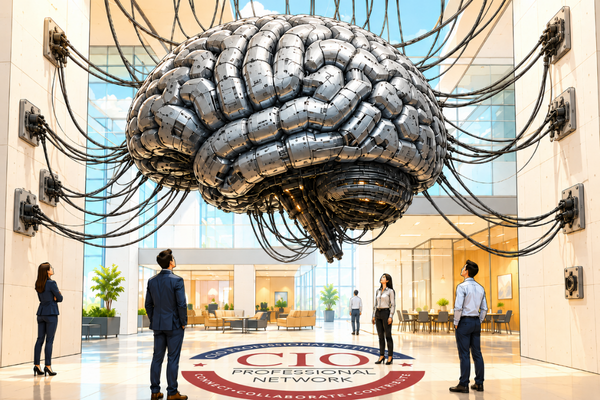
AI Enterprise Brain: From Fragmented AI to a Company Brain

One connected cranium.
David Eberly
Contributing Writer

The CIO Professional Network, the private CIO, CISO, and CTO community for The National CIO Review, gathered for a Learning Series discussion led by Sanjay Jeyakumar on how organizations can move from fragmented AI adoption to create a coordinated “company brain.” From his experience in machine learning, AI security, and recent work with CIOs across multiple industries, Sanjay shared examples of how companies are approaching AI transformation and the challenges emerging along the way.

Through the conversation, attendees helped weigh in on how CIOs can manage growing AI costs, tool sprawl, governance concerns, changing models, and pressure from business leaders to move faster.

Sanjay described how AI transformation requires organizations to rethink how work gets done and redesign important business workflows around a combination of human expertise and AI capabilities.

Through case studies and active member participation, the group explored how technology leaders can create focus and build an enterprise context layer that supports AI across the organization.

Why It Matters: AI tools are spreading across companies, which is leading organizations to risk creating disconnected systems, duplicate spending, and inconsistent controls. The takeaway was that CIOs should not build their AI strategy around a single model or vendor. They have to instead focus on the business context and organizational knowledge that can continue creating value as the underlying technology changes.

  • AI Transformation Starts with Redesigning Workflows: Sanjay defined AI transformation as the process of reconsidering how a company delivers value to its customers. Before generative AI, business workflows were completed primarily through human effort. Organizations now have the opportunity to redesign those workflows around both human capital and what Microsoft CEO Satya Nadella has described as “token capital.” Sanjay emphasized that this does not mean inserting AI into every task. It means identifying the workflows most responsible for creating customer value and deciding where AI can improve speed, quality, scale, or decision-making. For a software company, that might include the processes used to build and sell products, while in other industries, it could involve customer support or administrative work.
  • Usage Is Not the Same as Business Value: One company Sanjay described working with had made AI tools widely available and encouraged employees to increase their usage through leaderboards and performance incentives. Adoption increased, but so did token spending, and employees sometimes used AI for tasks that did not require it. An attendee noted that employees will naturally optimize around the metrics and incentives they are given. If AI usage contributes to a performance review or bonus, employees will find ways to increase usage whether or not it improves the business. The group discussed a similar issue in software development, where measuring the number of pull requests may increase activity without increasing the amount of valuable software delivered. The consensus was that companies should measure outcomes such as time saved, revenue improvement, risk reduction, or product delivery rather than prompts or generated activity.
  • Early Constraints Can Create Stronger Governance: Sanjay shared another example of a healthcare technology company that wanted to move quickly with AI but had to address strict requirements related to protected health information. The organization could not freely introduce public AI tools because it needed business associate agreements and greater control over where sensitive data was processed. It eventually created a controlled environment using models available through AWS Bedrock, allowing the company to manage its agreement through AWS and reduce the risk of sensitive information flowing directly to outside model providers. Although the company started more slowly, the constraints forced it to establish privacy and governance controls early, showing that moving carefully at the beginning can create a more sustainable foundation for future experimentation.
  • Uncontrolled Experimentation Can Lead to Tool Sprawl: A financial technology company Sanjay worked with took a broad approach by encouraging employees to select and purchase their own AI tools. While this approach accelerated experimentation, it also led to inconsistent controls and overlapping solutions for the same problems. In response, the CIO introduced a more centralized review process and concentrated investment on a smaller number of important workflows. The group reinforced that experimentation can create valuable learning, but it must be balanced with clear oversight of cost and business relevance.
  • The Enterprise Context Layer May Be More Valuable Than the Model: Sanjay argued that AI models will increasingly become interchangeable as new frontier and smaller models improve. Organizations may eventually select different models based on cost or the task being completed. The lasting strategic asset is therefore the context the model uses instead of the model. He described this context as the knowledge required to understand how the company operates and the information employees carry in their heads. By capturing this knowledge in a structured and portable form, organizations can create a company brain that supports multiple models and employee workflows without rebuilding the organizational context each time the technology changes.
  • Portability Should Be Part of the Build-Versus-Buy Decision: The group discussed how AI is changing the traditional decision between building a custom solution and purchasing an outside platform. Building can provide a closer fit with a company’s unique workflows and greater control over its architecture, but it also requires scarce talent and a strong business justification. On the other hand, buying can accelerate implementation, but may create limitations around customization and the ability to move organizational knowledge elsewhere. Sanjay recommended evaluating whether the context created inside a platform can be transferred to another model or system. Since vendors are still attempting to bundle models and context together, maintaining control over the knowledge can reduce long-term switching costs.
  • Focus on a Small Number of High-Value Workflows: The session concluded with a practical blueprint for enterprise AI adoption. Organizations may begin by providing a secure enterprise AI platform that establishes a minimum level of access and discourages employees from using unmanaged consumer tools. Leaders should then identify the two or three departments or workflows most responsible for creating customer value and concentrate their attention there. Those workflows can progress through a deliberate maturity path, beginning with AI assistance, advancing toward recommendations and supervised execution, and eventually reaching greater autonomy where appropriate. This focused approach gives CIOs a way to connect investment to business priorities while building the governance, knowledge, and operating practices required for broader transformation.

Go Deeper – AI Enterprise Brain: From Fragmented AI to a Company Brain (VIDEO) – CION Roundtable

☀️ Subscribe to the Early Morning Byte! Begin your day informed, engaged, and ready to lead with the latest in technology news and thought leadership.

☀️ Your latest edition of the Early Morning Byte is here! Kickstart your day informed, engaged, and ready to lead with the latest in technology news and thought leadership.

ADVERTISEMENT

×
You have free article(s) left this month courtesy of the CIO Professional Network.

Enter your username and password to access premium features.

Don’t have an account? Join the community.

Would You Like To Save Articles?

Enter your username and password to access premium features.

Don’t have an account? Join the community.

Thanks for subscribing!

We’re excited to have you on board. Stay tuned for the latest technology news delivered straight to your inbox.

Save My Spot For TNCR LIVE!

Thursday April 18th

9 AM Pacific / 11 PM Central / 12 PM Eastern

Register for Unlimited Access

Already a member?

Digital Monthly

$12.00/ month

Billed Monthly

Digital Annual

$10.00/ month

Billed Annually

Would You Like To Save Books?

Enter your username and password to access premium features.

Don’t have an account? Join the community.

Log In To Access Premium Features

Sign Up For A Free Account

Name
Newsletters