
“It ain’t about how hard you hit, it’s about how hard you get hit and keep movin’ forward. How much you can take, and keep movin’ forward. That’s how winning is done!” – Rocky Balboa
From a distance, the resilient can almost seem heroic.
We see the entrepreneur who carries a company through years of uncertainty, the leader who keeps guiding others when the path forward is unclear, the family that holds together through disappointment, or the individual who continues on when the road becomes far more demanding than expected.
But resilience is not measured by the outcome alone. It is revealed in how we move through difficult seasons before the ending is known.
It shows up when progress slows, confidence weakens, plans unravel, and the next step is not obvious.
There is no dramatic soundtrack in the middle of the storm. There is only the work still waiting, the responsibility still yours, and the decision to continue moving forward.
Not with fanfare.
Not with certainty.
Just with the willingness to take the next step.
That is resilience.
This Week’s Lesson: Resilience Is Built Before It Is Needed
Crisis reveals resilience. It rarely creates it.
It is shaped by the choices, habits, relationships, values, and rhythms that quietly prepare us for seasons we cannot fully predict.
Everyone eventually faces moments when the path is unclear, when confidence gets tested, when the organization is watching, and when the outcome is still uncertain. In those moments, the question is not whether pressure can be avoided. The question is what the pressure will reveal.
A leader who has created no margin will have little room to think when demands intensify. A team that has not built trust will struggle to stay together when trouble arrives. A person who has neglected the commitments that ground them will find it harder to remain level-headed when circumstances become unsettled. That is why resilience cannot be treated as a personality trait some people simply have and others do not.
It is built over time. It is strengthened through discipline. It is supported by relationships. It is anchored by values. And when the difficult season comes, it is revealed through response.
Leaders are often expected to absorb pressure without spreading anxiety, and rightly so. Teams need composure. Organizations need clear judgment. People need to know that someone is paying attention, telling the truth, and keeping the room from giving in to fear. But the best leaders are not those who appear unaffected.
The best leaders are those who remain grounded while affected.
They do not minimize reality. They do not manufacture certainty. They offer direction. They do not promise that everything will be easy. They help others believe the difficulty can be carried.
Hard seasons do more than test us. They reveal us.
They reveal whether our confidence has been built on appearance or conviction. They reveal whether our teams are connected by trust or merely aligned by convenience. They reveal whether our ambition is supported by character strong enough to carry responsibility when success is no longer immediate.
This is the forming work of resilience.
Over time, leaders who move through difficulty with humility often become more grounded. They listen better. They judge less quickly. They recognize the burdens others carry. They become less impressed by image and more attentive to character. And when pressure comes again, as it always does, they are better prepared to help others move through it without losing heart.
A difficult quarter is not the end of a company. A missed opportunity is not the end of a career. A hard season is not the end of a calling. Sometimes the most important thing a leader can do is keep the room from confusing pressure with defeat.

Three Ways to Practice this Week
- Build Margin Before You Need It: Resilience is harder to access when every part of life is already running at capacity. This week, look for one place where you can create a little more room before pressure arrives. Protect time for thinking. Close an unnecessary loop. Have the conversation you have been delaying. Margin may not feel urgent when things are going well, but it becomes valuable when demands increase.
- Strengthen the Commitments That Ground You: Resilience is built on what you return to when circumstances become uncertain. That may be your values, your faith, your family, your health, your team, or the promises you have made. This week, identify one commitment that needs attention and give it your focus. The strongest leaders are not held together by willpower alone. They are held together by the things they have chosen to honor before pressure arrives.
- Take Responsibility for the Experience You Create: Every meeting you enter, every message you send, and every conversation you hold shapes someone else’s experience. You may not control every variable, but you do control your preparation, your tone, and your follow-through. Above and beyond means refusing to say, “That’s not my job,” when you see confusion or friction. It means stepping in to clarify, simplify, and strengthen the outcome. Over time, people recognize who consistently leaves situations better than they found them.
The Wrap
Resilience is not the hardship itself. It is not the image others admire afterward.
It is the capacity to keep moving with character when circumstances test what you believe, how you lead, and who you are becoming.
It does not make a person unbreakable. It makes them dependable.
And over time, dependable leaders become the ones others trust most. Not because life was easy for them, and not because they always knew how the story would end, but because pressure did not get the final word.
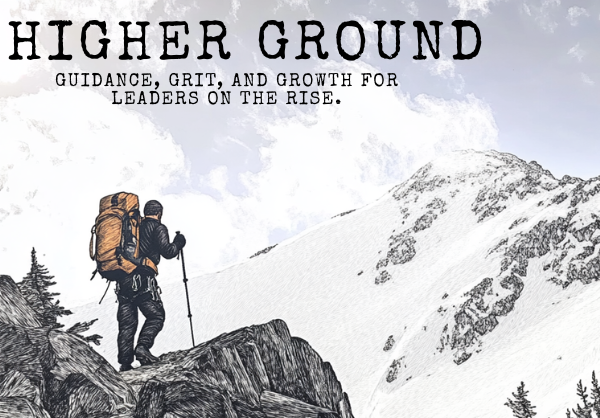
That is the higher ground.
Your Turn: Take a few minutes this week to reflect on a current challenge you are carrying, or a past season that required more resilience than you expected. What helped you keep going? What did you learn about your values, your limits, your support system, or your capacity to lead under pressure? If there are things you would handle differently now, receive that honestly without turning it into regret. Growth often comes from looking back with grace and looking forward with intention. Resilience is not about having handled every moment perfectly. It is about learning from what tested you, strengthening what still needs attention, and continuing forward with greater wisdom, humility, and hope.