
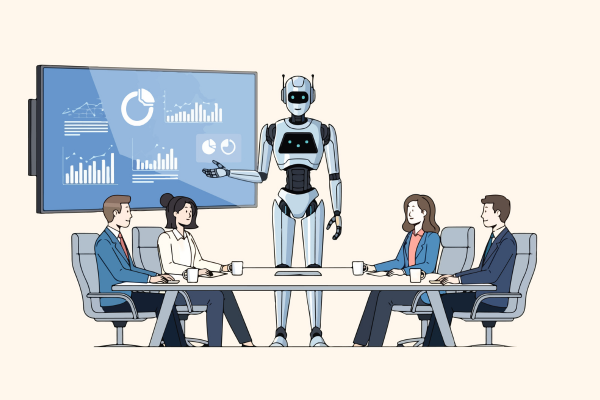
Most conversations about artificial intelligence and jobs focus on entry-level workers, analysts, programmers, or customer service teams. Yet one of the most significant transformations may be happening much higher up the organizational chart.
AI is changing leadership roles, forcing organizations to reconsider decision-making authority and the capabilities that matter most at the executive level.
According to a recent Harvard Business Review analysis, AI is changing the tools leaders use as well as the structure of leadership itself.
Traditional measures of executive success, including deep domain expertise, years of experience, and functional specialization, are giving way to qualities such as judgment, adaptability, and the ability to coordinate human and machine intelligence.
Leadership is becoming less associated with accumulated knowledge and more associated with the effective use of information.
Why It Matters: Intelligent systems now influence decisions, workflows, governance processes, and customer interactions across the enterprise. Leadership structures developed for a world where expertise remained concentrated and decision-making followed established lines of authority. AI is challenging those assumptions, prompting organizations to reconsider accountability and decision-making. Questions that once resided within technology functions are appearing in executive discussions and board conversations. Executive responsibilities, board oversight, and organizational structures continue to evolve as organizations determine how intelligent systems fit into the enterprise.

- Leadership’s AI Challenge: AI can no longer sit within a single department. Questions about governance and oversight are now a part of executive discussions. Leadership teams are evaluating where AI should participate in decision-making and where human responsibility remains essential. The conversation extends beyond technology implementation and into the management of the enterprise itself.
- Judgment Matters More: AI systems can analyze information, generate recommendations, and model outcomes with growing sophistication. Expertise alone carries less weight as a source of advantage. Organizations are placing greater value on judgment and the ability to apply context when evaluating information. Leaders must evaluate AI-generated recommendations, identify when context changes the answer, and make decisions that machines cannot make on their own. The ability to interpret information is becoming more valuable than the ability to accumulate it.
- The AI enabled C-Suite: AI is expanding expectations across established executive functions. Finance leaders are evaluating how predictive technologies influence planning and forecasting. Human resources leaders are examining how AI may affect workforce strategy and skills development. Operations leaders are determining where intelligent systems can improve efficiency while maintaining accountability.
- Governance Meets AI: AI is unlikely to function as a substitute for executive leadership. Intelligent systems are becoming part of leadership workflows and decision processes. New roles focused on AI governance and human-machine collaboration may emerge. Organizations are also rethinking how leadership is structured, with greater emphasis on combining human judgment and machine intelligence within the same operating framework.
- Leadership by Design: AI is unlikely to function as a substitute for executive leadership. As intelligent systems become embedded in leadership workflows and decision processes, executives are adapting how they evaluate information, make decisions, and exercise oversight. Organizations are also expanding responsibilities related to AI governance and human-machine collaboration. As these changes continue, leadership models may place greater emphasis on coordinating human judgment with machine intelligence within the same operating framework.
Go Deeper -> How C-Suite and Board Roles Are Being Reshaped Around AI – Harvard Business Review