



The difficult question is no longer whether Jensen Huang should return to the helm of Nvidia.
The board has answered that question.
The harder question is what a return to command must require when the company at issue sits at the center of the strategic competition with China.
Huang resigned earlier this month after reports that he had been in a relationship with a suspected Chinese intelligence asset. Yesterday morning, 11 days later, Nvidia’s board reinstated him as president, CEO, and director.
The decision may be settled. The obligations created by the episode are not.
Advanced chips, frontier AI models, hyperscale cloud, and semiconductor equipment are no longer merely commercial products. They are the terrain on which national power will be built and contested. The leaders of the companies that control them are therefore national-security assets in everything but name.
The situation calls to mind General George Patton’s temporary removal during World War II. After Patton slapped a shell-shocked soldier in Sicily, the press demanded consequences. General Dwight Eisenhower had to weigh the offense against the fact that Patton was his most capable field commander, and that the German high command assessed him as the most capable Allied commander.
Permanently removing Patton would have removed a major chess piece from the Western Front.
Eisenhower’s answer was neither indulgence nor permanent exclusion.
Patton returned under direct oversight.
That is the relevant precedent for Nvidia: indispensability may explain a return, but it cannot substitute for accountability.
Accountability Is the Price of a Return
The right response is a three-layer framework. The board must create independent oversight. Huang must accept personal obligations that match the sensitivity of his position. Industry and government must establish common rules so that national-security accountability does not depend on the identity of one executive or the discretion of one board.
Three layers of accountability:
- Nvidia’s board: independent expertise, authority, investigation, and succession planning.
- Huang himself: damage assessment, disclosure, testimony, and leadership on enforcement.
- Industry and government: shared obligations for strategic technology leaders.
The first layer is Nvidia’s board.
It should take the country’s post-election mood seriously and implement transparent, concrete oversight. The 2026 midterm elections were very much a referendum on the lack of Congressional oversight.
The board should not wait for Congress to define the standard, and it should not treat the reinstatement as the end of the matter.
The second layer is Huang himself.
He should complete the FBI’s counterintelligence damage assessment, turn his debrief into an industry case study, report foreign contacts as cleared personnel do, testify before Congress, and lead on workable export-control enforcement.
The third layer belongs to industry and government.
A small set of known national-security obligations should extend to leaders of strategic firms: foreign-contact disclosure, defensive counterintelligence briefings, insider-threat programs that include the C-suite, CEO certification of export compliance, and a defined process for responding when a leader is targeted
Going Forward: The Next 90 Days
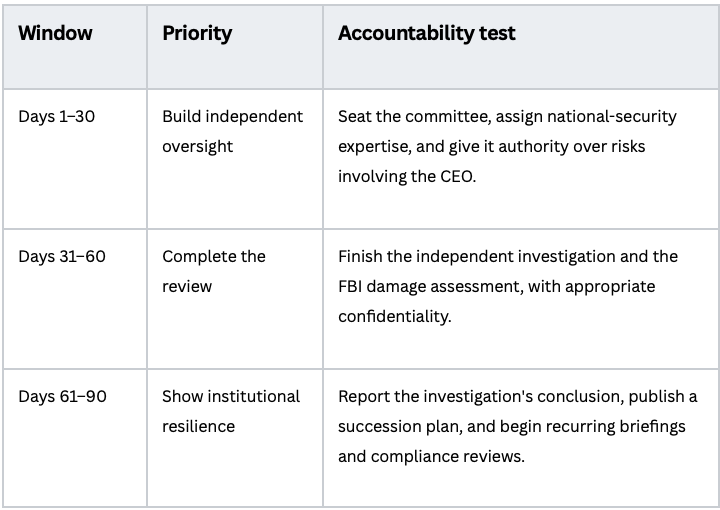
The first 90 days should convert a public controversy into a durable accountability system. The sequence matters: establish independent expertise, complete the factual review, disclose what can be disclosed, and make sure the company is not dependent on one indispensable leader.
Nvidia’s Board: Four Measures for the Next 90 Days
- Seat the new committee with real national-security expertise. At least one independent director should have senior intelligence, counterintelligence, or export-control experience. The committee should receive regular threat briefings from the FBI and the Commerce Department’s Bureau of Industry and Security.
- Give the committee direct authority over national-security risk at the top. The new chief compliance officer and the company’s insider-threat function should report to this committee, not to the CEO, on any matter involving the CEO.
- Finish the investigation and report its conclusion. The board can keep details confidential. It should still state publicly when the independent investigation is complete and whether it found any compromise of company or national-security information.
- Publish a succession plan. Huang’s resignation exposed a company with no obvious successor, and an adversary has now tested that weakness. Eisenhower always had General Omar Bradley. Nvidia needs a credible bench, and the board should say it has one.
Huang Himself: Make the Return Defensible
The most credible way for Huang to resume command is to make his own conduct part of the accountability system. That means accepting scrutiny not as a concession to critics, but as a protection for Nvidia, its employees, its investors, and the national interest tied to its technology.
- Complete the counterintelligence damage assessment, and say so. Input from senior officials is not the same as a completed FBI review. Huang should cooperate fully and confirm publicly when the work is finished.
- Turn his debrief into a defense for the industry. How he was approached, through which channels, and what was asked is one of the most valuable counterintelligence case studies in years. A sanitized version should become the basis of defensive briefings across the AI, semiconductor, and cloud sectors.
- Hold himself to the reporting standard of a cleared engineer. Huang should voluntarily report close and ongoing contacts with foreign nationals from countries of concern through a confidential government channel, as cleared personnel do under SEAD 3.
- Answer to Congress. In June, Huang declined Senator Warren’s invitation to testify on export controls and Nvidia’s China business. Accountability now means accepting the next invitation and testifying openly about how Nvidia keeps its most powerful chips out of the wrong hands.
- Lead on enforcement. Chip diversion through third-country intermediaries is the gap Beijing exploits. Megaspeed itself was under investigation for it. A reinstated Huang who publicly backs workable location verification for advanced chips
Industry and Government: A Standard for Every Strategic Technology Leader
The lesson should not be confined to Nvidia.
Strategic technology firms need a predictable standard that protects legitimate business activity while recognizing that their leaders are valuable targets. The goal is not to turn every executive into a cleared employee; it is to extend proven safeguards to the people with the greatest access and influence.
- Foreign-contact disclosure. Model the requirement on SEAD 3, which requires cleared personnel to report continuing associations with foreign nationals involving bonds of affection, personal obligation, or intimate contact.
- Mandatory defensive briefings. Require FBI counterintelligence briefings before foreign travel and at least annually. Every cleared engineer in the defense industrial base gets this. The people at the top are the most valuable targets and should get it first.
- Insider-threat programs that cover the C-suite. The NISPOM requires insider-threat programs and suspicious-contact reporting at cleared contractors. Strategic firms should extend that discipline to their executives.
- CEO certification of export compliance. Sarbanes-Oxley made CEOs personally certify financial controls. Leaders of firms selling export-controlled AI hardware should personally certify that their anti-diversion programs work.
- A known process when a leader is targeted. The process should include an independent counterintelligence review, a completed finding, and a decision based on that finding—applied the same way no matter who the executive is or whom he knows.
The Wrap
We usually remember Patton’s story as a story of indispensability. It is just as much a story about the terms of a return.
Eisenhower brought Patton back because he judged him essential, but Patton’s return was made credible by the system of accountability around him. General Omar Bradley’s presence underscored that even an indispensable commander needed institutional checks.
Jensen Huang is back in command.
What should define this moment is not simply that an important leader returned, but that an American system brought its best commander back and still held him to account. Nvidia’s board, Huang himself, and the wider technology industry now have a chance to make that standard real.
Beijing is counting on the United States to skip the second step.