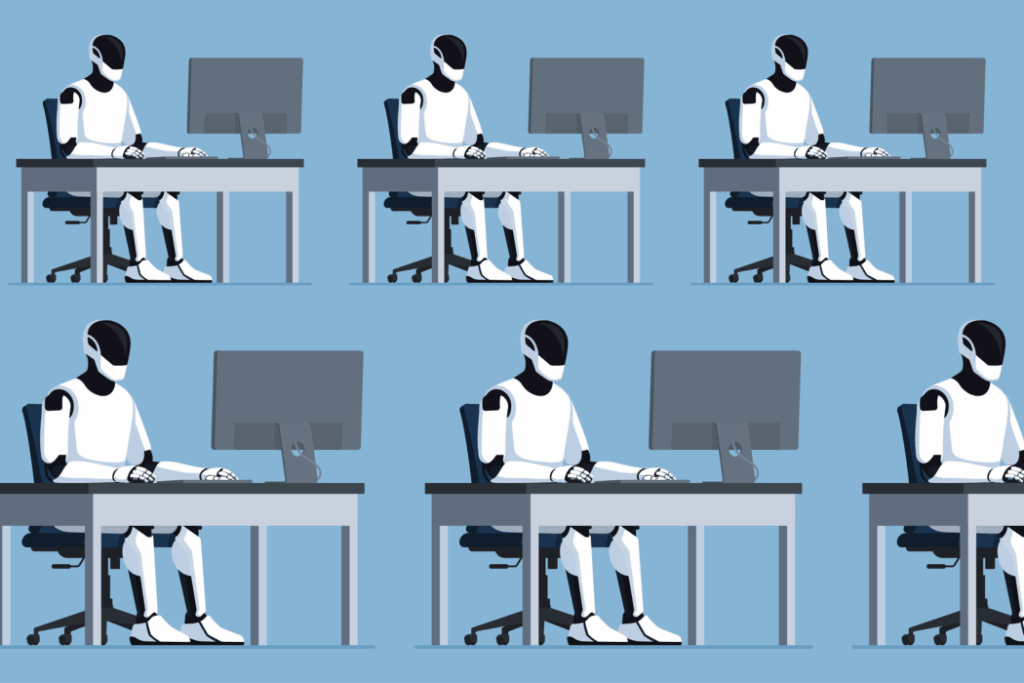
In Part 1, The Employee Without a Name, I described three companies that deployed autonomous AI agents and kept calling them tools, bots, and systems. Each agent was acting on its own authority, accumulating institutional knowledge, and operating across core enterprise systems without a human in the loop for every decision.
The language was comfortable. It was also wrong. These agents are not tools. They are something categorically different. And in most organizations, they are completely ungoverned.
There is a more precise word. They are digital employees.
What Makes a Digital Employee
A digital employee is an autonomous AI agent that meets four conditions at the same time.
- A persistent mandate. It has a defined role and ongoing operational responsibility that doesn’t end when a task closes.
- Consequential autonomy. It makes decisions with real financial, operational, or data consequences without requiring approval for each decision. It acts under delegated authority.
- Accumulated institutional knowledge. Its decisions evolve based on experience within your specific organization. It encodes your context, your relationships, and your exception patterns. Knowledge no one else holds in quite the same form.
- Deep system integration. It maintains active connections to two or more enterprise systems and initiates actions across them as part of its mandate.
An agent that meets all four is not a tool you use. It is a workforce participant you are responsible for governing.
A tool requires maintenance. A digital employee requires management.
That distinction is not semantic. The governance obligations that follow from each are entirely different.
Side by Side
The gap becomes clear when you place them side by side.
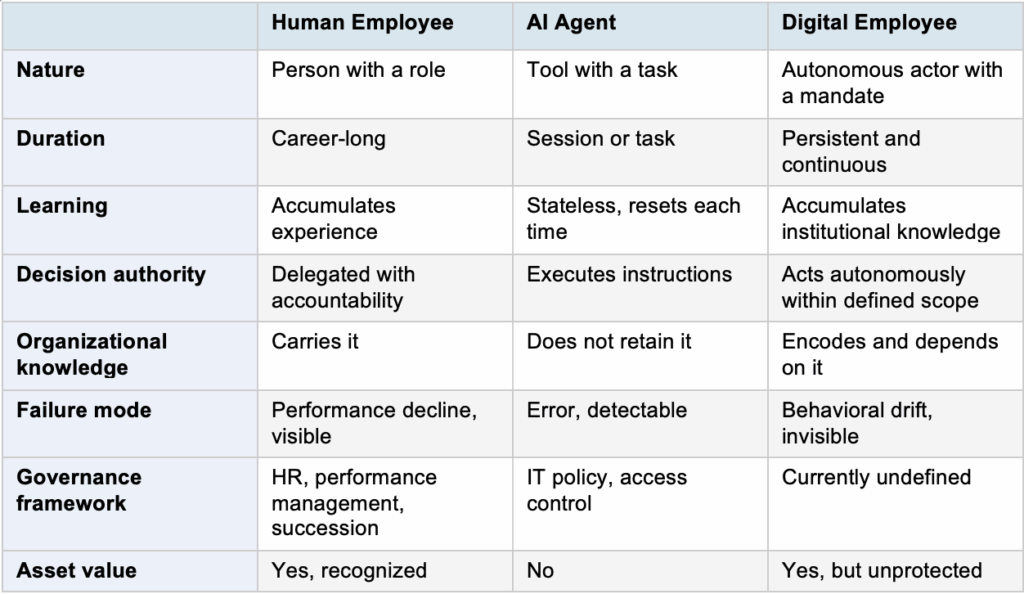
Look at the last two rows.
Every human employee in your organization sits inside a governance framework: performance management, accountability structures, succession planning, knowledge transfer. You don’t treat that as optional. It is how you manage the people who carry your operational intelligence and make consequential decisions on your behalf.
Your digital employees have none of it. They operate with the authority of an employee and the governance of a software subscription. They carry institutional knowledge that in some cases took years to build and exists nowhere else. That knowledge is currently unprotected, unmeasured, and unrecognized as a corporate asset.
Now look at the failure mode row.
Human failure is visible. Performance drops, behavior shifts, managers notice. AI agent failure is detectable. It throws an error, triggers an exception, generates a log entry.
Digital employee failure is neither. It is behavioral drift, a slow and quiet deviation from established decision patterns that falls below every security threshold and produces no error messages. It is invisible until the consequences have been compounding for months.
The Question Your Board Will Ask
Board oversight of AI risk has tripled in the past year. Nearly half of Fortune 100 companies now address AI governance in their proxy statements. Risk committees are asking questions their organizations cannot yet answer.
Not “are our AI systems secure?” That question at least has a framework and an owner.
The question without an answer is this:
- Are our autonomous agents still making the decisions we intended them to make?
- Are they managing our operational relationships faithfully?
- Are they protecting the institutional knowledge our organization depends on?
These are not security questions. They are governance questions, the same questions you would ask about any employee with significant delegated authority and irreplaceable organizational knowledge.
We don’t yet have the frameworks to answer them.
Where This Goes
Naming your agents as digital employees is not the end of a conversation. It is the start of one.
- How do you know your digital employees are still performing as intended, not just within their security boundaries, but consistent with their original mandate and your organizational intent?
- How do you protect the institutional knowledge they carry?
- What happens to that encoded knowledge when the agent is updated, replaced, or shut down?
- How do you account for their value? The decision capability they represent is a genuine organizational asset, whether your balance sheet reflects it or not.
These questions will move from interesting to urgent as organizations scale their digital employee populations from dozens to hundreds to thousands.
The first step is recognizing what you are dealing with.
You have already hired your digital employees. The question now is whether you are managing them.