The debate surrounding higher education in technology has changed dramatically over the past decade. Skills-based hiring has gained momentum. Professional certifications have become more respected. Nontraditional career paths have challenged long-held assumptions about what prepares someone for leadership.
Yet few topics continue to generate as much discussion as the value of a college degree.
To better understand how today’s executives view formal education, TNCR | Executive Research surveyed CIOs and senior technology leaders on the role of bachelor’s degrees, master’s degrees, and higher education in hiring, advancement, and executive leadership. The findings suggest that while technology leaders continue to value higher education, many no longer view a degree as the deciding factor in career advancement. Instead, experience, demonstrated results, and leadership capability increasingly shape who earns executive opportunities.
A Foundation, Not a Requirement
The research makes one thing clear immediately: technology leaders have not dismissed higher education.
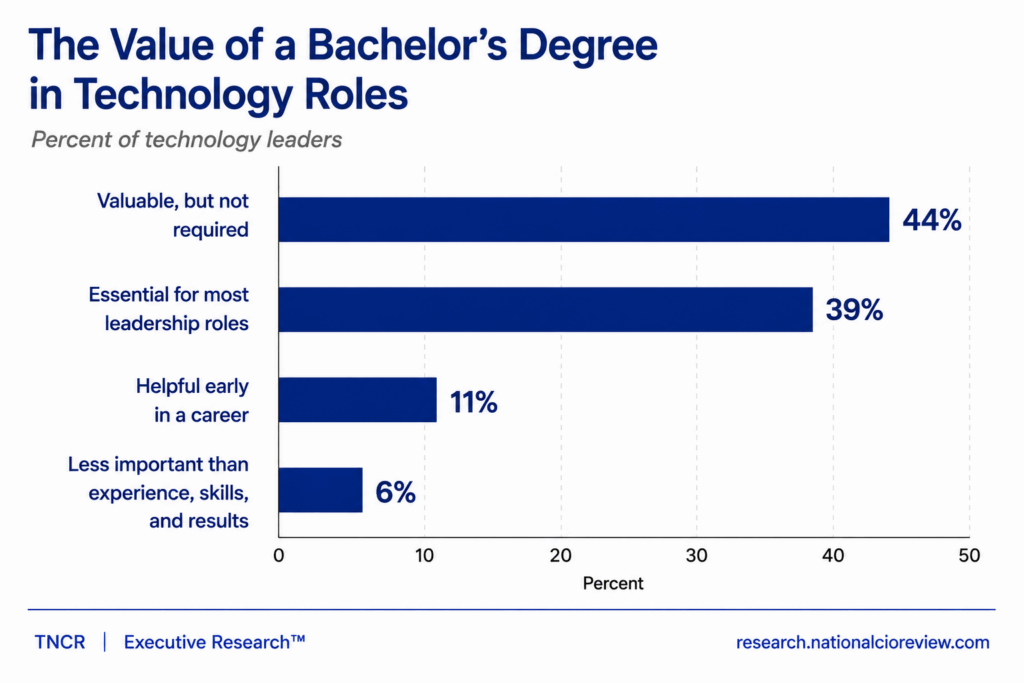
When asked about the value of a bachelor’s degree for professionals pursuing technology leadership roles, contributors were closely divided. Thirty-nine percent said a bachelor’s degree remains essential for most leadership roles, while 44% said it is not required, but valuable, but not required.
That distinction is important.
Monica Pemberton, Vice President and Chief Information Officer at the American Council on Education, reflected that balance, explaining that formal education establishes a strong foundation early in a career. As professionals advance, leadership, business impact, executive presence, and strategic thinking become increasingly important. Scott Kelly, Vice President of Technology at Office Pride, similarly noted that while education strengthens expertise, executive advancement depends on practical leadership, managing complex initiatives, and consistently delivering business outcomes.
Still, not every contributor viewed degree requirements as loosening. Raj Murthy offered a more traditional counterpoint, arguing that degrees continue to influence credibility and advancement:
“If you want respect, you’ll need a degree.”
Raj Murthy, Chief Technology Officer at George Mason University
Experience Changes the Equation
That shift becomes even clearer when contributors were asked how they evaluate technology leadership candidates.
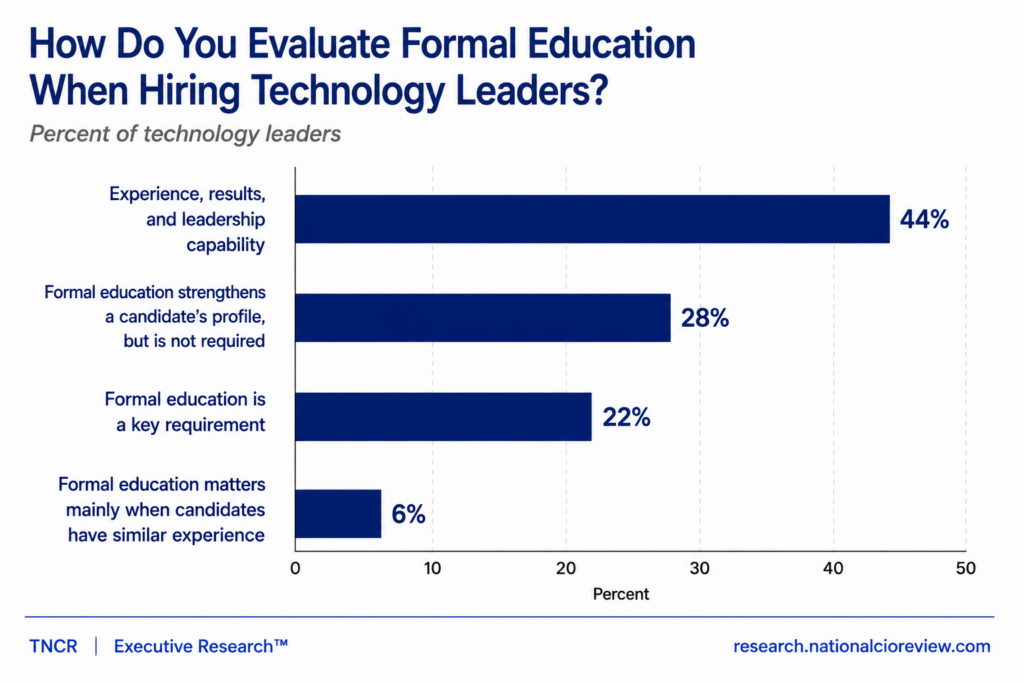
The largest group of TNCR | Executive Research contributors, 44%, said experience, demonstrated results, and leadership capability carry the greatest weight. Another 28% said formal education strengthens a candidate’s profile but is not required, while 22% still consider formal education a key requirement. Just 6% said education primarily matters when candidates have similar experience.
The responses suggest that organizations are looking beyond credentials to understand what candidates have actually accomplished.
Technology leaders are expected to build teams, influence strategy, lead organizational change, communicate with executives, and consistently deliver measurable business value. Those are capabilities developed through experience rather than earned through a diploma.
Scott Kelly reinforced that perspective.
“Advanced education can strengthen expertise in areas such as business strategy, leadership or finance, but getting to the next level also depends heavily on practical experience leading teams, managing complex projects, and driving business outcomes.”
Paul Mohabir expressed a similar view.
“The most successful technology executives combine continuous learning with a proven track record of delivering business outcomes, building high-performing teams, and leading change.”
Paul Mohabir, Head of IT at Transervice Logistics
Harsha Bellur, Chief Information Officer at James Avery Jewelry, also observed that degrees increasingly demonstrate commitment to continuous learning and disciplined thinking rather than serving as a standalone indicator of executive readiness.
Collectively, the responses suggest that hiring decisions have become far more holistic. Formal education may help candidates earn consideration, but leadership performance increasingly determines who earns executive responsibility.
The Graduate Degree Question
The survey found similar nuance when contributors considered graduate education.
Forty-four percent of TNCR | Executive Research contributors said a master’s degree is valuable because it strengthens leadership, strategic thinking, or business credibility. Another 17% believe it remains essential for certain executive leadership positions. At the same time, 22% believe executive experience ultimately outweighs graduate credentials, while 11% described a master’s degree as helpful, but not necessary.
Those findings suggest graduate education has become more purposeful.
Rather than recommending another degree for every technology professional, contributors consistently encouraged aspiring leaders to pursue graduate education when it fills a specific leadership or business need.
Kiran Palla, Chief Technology Officer at Anika Systems, encouraged professionals to consider whether graduate education strengthens business acumen, leadership credibility, executive networking opportunities, or supports a meaningful career transition.
Charles Burton, Information Technology Director for the Calcasieu Parish Police Jury, summarized his perspective simply.
“A master’s is important for executive leadership roles.”
Lonnie Garris, Cybersecurity Consultant at Riomar Group, emphasized that learning should continue long after earning a graduate degree.
“The master’s degree demonstrates comprehensive knowledge and critical thinking. However, continue to strive for the highest level certifications, which demonstrate competence.”
The consistent message throughout the research is that graduate education creates the greatest value when it complements experience rather than attempts to replace it.
Why the MBA Stands Out
One of the clearest findings in the survey involved the type of graduate education contributors value most.
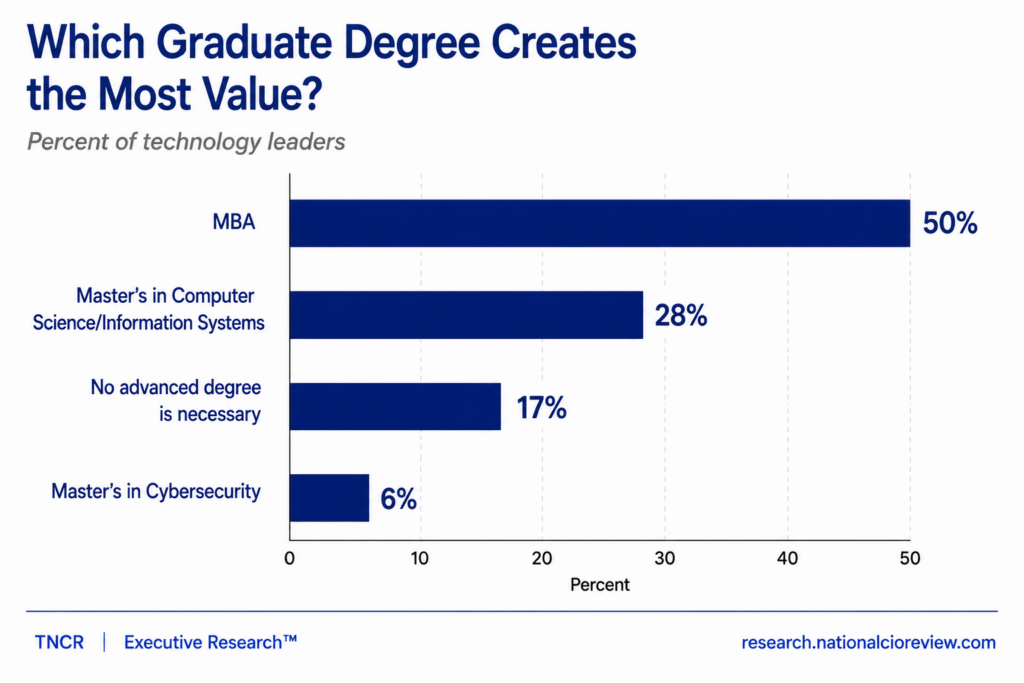
When asked which advanced degree best prepares professionals for senior technology leadership, 50% selected an MBA. That exceeded master’s degrees in computer science or information systems at 28%, while only 6% selected cybersecurity. Another 17% said no advanced degree is necessary.
The preference for the MBA reflects how dramatically the CIO role has evolved.
Today’s technology executives are expected to shape enterprise strategy, oversee major investments, communicate with boards, partner with finance leaders, and connect technology initiatives directly to business performance.
Rocky Vienna, Managing Director of Vienna Technology Group, LLC, summarized that evolution succinctly.
“Finance is the language of business. As a senior technology exec you’ll be partnering with the CFO.”
Joe Gross, President and Managing Partner at CIO Partners, also encouraged experienced technology leaders to think carefully about the type of graduate education they pursue. Rather than recommending another technical degree, he suggested that professionals with established technology leadership experience may gain greater value from an MBA, arguing that technology has become so intertwined with business that executive success increasingly depends on business leadership.
Brian Thomas, VP & CIO at Contech Control Services, Inc., similarly observed that graduate education delivers the greatest value when it expands business understanding alongside technical expertise.
The research suggests that technical knowledge remains essential, but business fluency increasingly separates executive technology leaders from technical specialists.
When Education Matters Most
Contributors also identified where formal education creates the greatest value throughout a career.
The largest share, 30%, said education matters most in executive-level roles. Another 20% pointed to early-career hiring, while another 20% selected management positions. Thirteen percent identified regulated or highly credentialed environments, 7% selected consulting, advisory, or client-facing roles, another 7% pointed to technical specialist roles, and 3% said it depends more on the individual than the role.
Those responses reinforce an important theme running throughout the research.
The role of education changes as careers progress.
Early in a career, degrees help establish credibility and demonstrate foundational knowledge. Later, organizations increasingly evaluate leadership effectiveness, business judgment, communication skills, and measurable accomplishments alongside academic credentials.
Rather than competing with one another, education and experience reinforce one another throughout a technology leader’s career.
The Wrap
The latest TNCR | Executive Research findings show that degrees still have value, but their influence in technology leadership appears to be shifting.
Bachelor’s and master’s degrees can establish credibility, strengthen business knowledge, and open doors. Yet the research also points to a rising emphasis on experience, demonstrated results, and leadership capability. For many technology leaders, formal education remains valuable, but it is carrying less weight as a standalone measure of executive readiness.
For aspiring technology leaders, the message is clear: education can help create opportunity, but advancement depends on what you do with it.
About TNCR | Executive Research
TNCR | Executive Research is a peer-driven research platform from The National CIO Review that captures timely perspectives from CIOs, technology executives, and digital leaders on the issues shaping enterprise technology. Each research initiative combines quantitative insights with practitioner commentary to help leaders benchmark priorities, understand emerging risks, and make more informed decisions.
The platform is designed to elevate the voices of technology leaders while providing the broader executive community with actionable insights grounded in real-world experience.
We use analytics and similar technologies to help us understand how people ineract with The National CIO Review, improve our services, and measure the effectiveness of our outreach. You can accept, decline, or manage your choices. Your choice is saved on this device. See our Privacy Policy.
Strictly Necessary
Always active
Required for the site to work (sign-in, security, and your saved preferences). Always on.
Preferences
The technical storage or access is necessary for the legitimate purpose of storing preferences that are not requested by the subscriber or user.
Analytics
Helps us understand how people use The National CIO Review and improve our services.The technical storage or access that is used exclusively for anonymous statistical purposes. Without a subpoena, voluntary compliance on the part of your Internet Service Provider, or additional records from a third party, information stored or retrieved for this purpose alone cannot usually be used to identify you.
Marketing
Helps us measure the effectiveness of our outreach and communications.
We use analytics and similar technologies to help us understand how people interact with The National CIO Review, improve our services, and measure the effectiveness of our content. You can review your privacy choices at any time. Your choice is saved on this device. See our Privacy Policy.
Strictly Necessary
Always active
Required for the site to work (sign-in, security, and your saved preferences). Always on.
Preferences
The technical storage or access is necessary for the legitimate purpose of storing preferences that are not requested by the subscriber or user.
Analytics
Helps us understand how people use The National CIO Review and improve our services.The technical storage or access that is used exclusively for anonymous statistical purposes. Without a subpoena, voluntary compliance on the part of your Internet Service Provider, or additional records from a third party, information stored or retrieved for this purpose alone cannot usually be used to identify you.
Marketing
Helps us measure the effectiveness of our outreach and communications.