
Enterprise AI has moved past the hype cycle and into the accountability cycle.
Most CIOs can point to successful pilots, early productivity gains, and growing enthusiasm from business teams. Yet many of those wins stall when leaders try to scale AI across geographies, functions, and thousands of users.
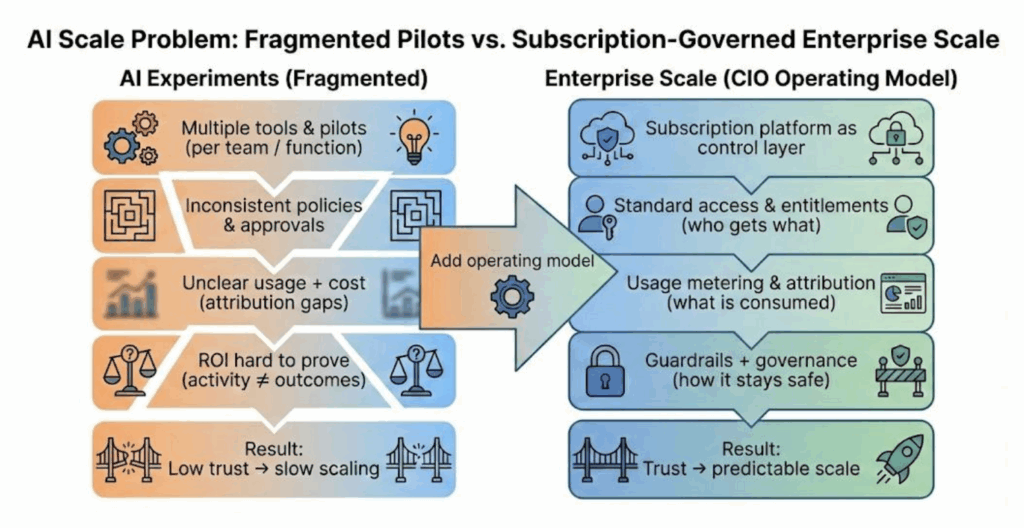
The core issue is that most enterprises are trying to scale AI without a modern way to run and govern the economics of AI.
In board conversations, the questions are evolving quickly. “What can AI do?” is being replaced by “What does AI cost us, how do we control it, and how do we prove it’s improving business outcomes quarter after quarter?”
When those questions don’t have crisp answers, funding becomes cautious, adoption becomes uneven, and AI drifts into a fragmented set of local experiments.
That is why subscription platforms are becoming a CIO imperative.
Not because CIOs suddenly want more billing systems, but because subscription platforms are increasingly the most practical way to turn AI into an enterprise capability that is measurable, governable, and scalable
Why the Change?
AI is different from traditional enterprise software in one important way: it behaves like consumption.
Costs rise with usage. Value should rise with usage too, but only if usage is tied to real workflows and real outcomes.
When AI is deployed without clear guardrails, enterprises experience cost volatility at the exact moment adoption starts to work. That is a predictable recipe for executive distrust.
At the same time, AI amplifies risk.
It touches sensitive customer information, internal IP, regulated datasets, and third-party services.
When different teams adopt different tools with different policies, governance becomes inconsistent and hard to defend. The organization either slows down under the weight of approvals or speeds up and creates shadow AI. Both outcomes reduce ROI.
The enterprise needs a way to scale AI with control. That requirement is an operating model problem.
What Problem Does a Subscription Platform Solve?
Most leaders hear “subscription platform” and think of monetization or invoicing, but CIOs should think of something broader.
A subscription platform is a control layer that allows the enterprise to define how AI is offered internally and externally with clear access, clear limits, clear measurement, and clear accountability.
In practical terms, subscription platforms help an enterprise answer question that boards and CFOs increasingly ask:
- Who has access to which AI capabilities?
- What consumption is driving cost?
- How do we forecast AI spending and prevent runaway budgets?
- How do we enforce consistent governance policies?
- Which use cases are producing measurable outcomes and should be scaled further?
Without a control layer, AI becomes a collection of scattered tools.
With one, AI becomes a managed service.
What Should CIOs Do Differently?
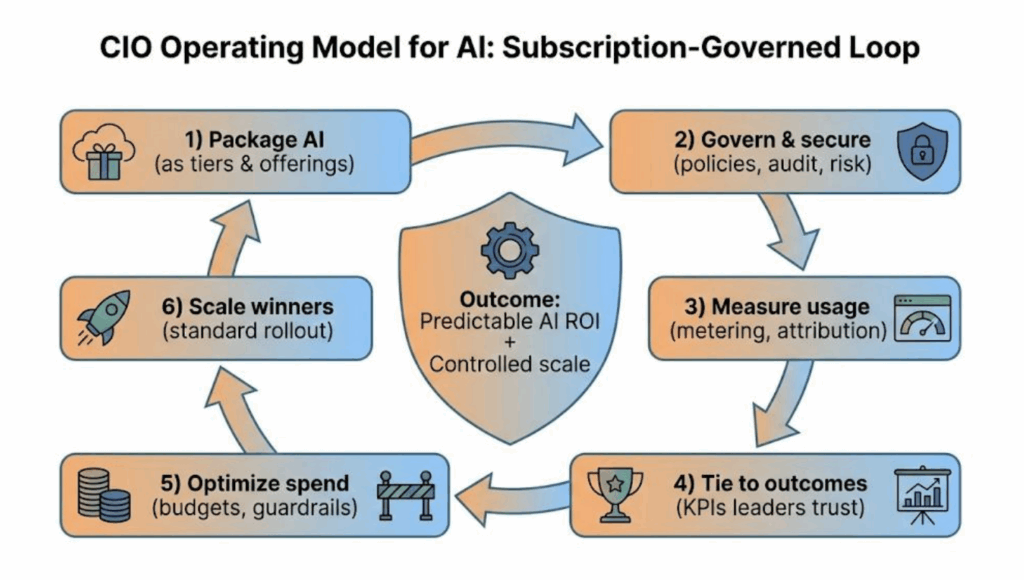
CIOs need to shift the conversation from “deploying AI” to “running AI.”
That shift is less technical than it sounds. It starts with creating a common structure for adoption, governance, and value measurement.
Subscription platforms provide an effective foundation for this structure because they create repeatability.
Step 1: Standardize How AI is Offered to the Business
Instead of every function sourcing its own copilots and workflows, the enterprise should define a small set of approved AI capabilities and provide a clear path for onboarding. This reduces fragmentation and makes governance scalable.
Step 2: Tier Access Based on Risk and Business Value
In most large enterprises, not every AI use case should be treated the same. Some use cases are low-risk and broad (employee productivity). Others are high-value but need tighter guardrails (customer-facing interactions, revenue and pricing decisions, regulated data).
Tiering allows CIOs to scale adoption without treating every new rollout as a one-off policy debate.
Step 3: Build Spending Guardrails that Scale with Adoption
This is where the subscription model becomes powerful. Once access and usage are structured, CIOs can forecast demand, set limits, and align funding mechanisms with the outcomes leaders are about. The goal is to prevent financial surprises that erode confidence.
Step 4: Measure Success in Outcomes, Not Deployments
Most AI programs can report activity. Far fewer can report durable business impact.
CIOs should insist on metrics that leadership recognizes immediately such as, cycle time reduction, forecast confidence, conversion improvements, renewal predictability, support resolution outcomes, and other operational indicators that show whether AI is changing how the enterprise executes.
When those measures become consistent, AI stops being a technology story and becomes a performance story.
What Questions Should the Board Ask the CIO?
Boards don’t need AI jargon, but they do need clarity.
If CIOs want to earn confidence for scaling AI investment, they should be prepared to answer questions like these:
- How are we controlling AI consumption costs as adoption grows, and can we forecast spending with confidence?
- What governance standards exist across business units, and how do we prevent fragmented or shadow deployments?
- Which use cases have proven measurable outcomes, and what is the roadmap to scale the winners?
- Are we treating AI as isolated tools, or as an enterprise service with consistent access, accountability, and controls?
- Do we have an operating model that allows AI to expand safely without slowing down innovation?
When a CIO can answer those questions with a simple, repeatable framework, the organization is ready to scale.
Where Does This Leave Us?
The AI economy will not be won by the enterprises with the most pilots. It will be won by the enterprises that can scale AI with trust, control, and predictable value.
Subscription platforms are becoming a CIO imperative because they provide the missing operating layer, the mechanism that turns AI from experimentation into an enterprise capability that leaders can fund, govern, and expand quarter after quarter.
The opportunity for CIOs is to lead this shift now.
The organizations that build the operating model early will be the ones that turn AI into sustained advantage, while others remain stuck in perpetual pilots.