

AI is no longer a distant promise or a technology reserved for experimental pilots. Instead, it is now central to how organizations deliver business value. With this critical shift, CIOs are expected to deploy AI and demonstrate its tangible impact on cost reduction, revenue growth, and employee experience.
With CEOs consistently ranking AI as the most transformative technology for their organizations, technology leaders must move beyond activity-based metrics and focus on outcomes that drive financial and strategic success.
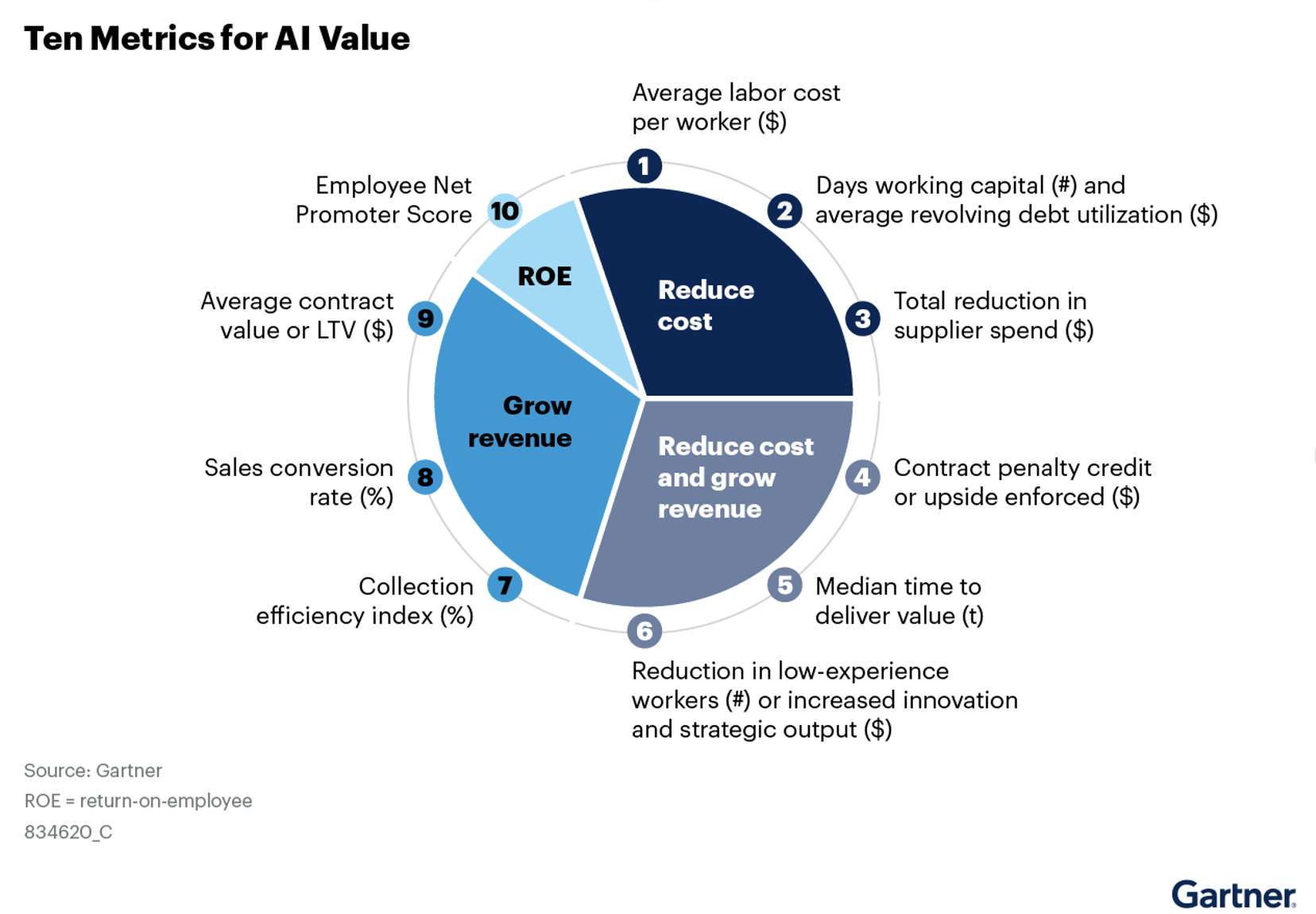
There are ten outcome-driven metrics that leading organizations are already using today to measure and communicate AI’s business value. These metrics are grouped into three categories:
- Cost reduction
- Revenue growth
- Return on employee
They provide a practical framework for CIOs to align AI initiatives with executive priorities.
Cost Reduction Metrics
The first category focuses on how AI can optimize operational efficiency and reduce expenses.
For example, “Average Labor Cost Per Worker” captures the impact of AI-driven skill acceleration, enabling junior employees to perform at higher levels and allowing organizations to rebalance workforce composition without sacrificing output.
By compressing the time to competency, AI empowers CIOs to partner with leaders in customer service, finance, or IT to quantify and realize labor cost savings.
Similarly, “Days Working Capital” and “Average Revolving Debt Utilization” highlight AI’s ability to enhance cash flow forecasting and financial agility. By integrating structured and unstructured data, AI enables finance teams to improve forecast accuracy, optimize working capital, and reduce reliance on expensive credit lines.
Even incremental improvements in cash management can yield immediate bottom-line benefits.
“Total Reduction in Supplier Spend” is another powerful metric, reflecting AI’s role in renegotiating supplier contracts, reducing reliance on external providers, and lowering switching costs. CIOs who collaborate with procurement and business unit leaders can use AI to identify opportunities for insourcing, drive competitive pricing, and capture value from supplier relationships.

Revenue Growth Metrics
On the growth front, “Collection Efficiency Index” measures how AI transforms accounts receivable processes by personalizing collection strategies, optimizing exception handling, and improving cash flow. Organizations implementing AI in collections report significant improvements in days sales outstanding, especially in complex B2B environments.
“Sales Conversion Rate” highlights AI’s ability to influence customer behavior through emotional intelligence and cognitive effort reduction. AI-guided interactions can dramatically increase conversion rates by tailoring messaging, simplifying decision-making, and augmenting sales teams with real-time insights.
CIOs partnering with commercial leaders can use this metric to quantify the impact of AI on top-line growth.
“Average Contract Value or Lifetime Value” demonstrates how AI-driven customer engagement creates continuous value, increases cross-selling opportunities, and strengthens loyalty. By providing proactive, contextual assistance, AI moves customer relationships from transactional to consultative, resulting in higher contract values and repeat business.
“The organizations that succeed will be those that treat measurement as an ongoing discipline.”
Metrics Driving Both Cost Reduction and Revenue Growth
AI’s versatility is evident in metrics that impact both sides of the financial equation. “Contract Penalty Credit or Upside Enforced” demonstrates how AI can proactively monitor and enforce contract terms, identifying breaches and opportunities for bonuses with greater speed and accuracy than manual processes.
This not only recovers lost value but also strengthens compliance and negotiation outcomes.
“Median Time to Deliver Value” captures the speed at which AI enables organizations to launch new products or implement cost-saving enhancements. By accelerating cycle times, CIOs can pull forward revenue realization, reduce overhead, and gain competitive advantage.
The ability to measure and compress time-to-value is increasingly seen as a direct proxy for organizational agility and innovation.
“Reduction in Low-Experience Workers or Increased Innovation and Strategic Output” reflects AI’s capacity to magnify the impact of high-experience employees in complex roles. CIOs should work closely with HR and business leaders to identify high-value roles and tailor AI solutions that unlock creative and strategic capacity.
Return on Employee Metric
Finally, “Employee Net Promoter Score” (NPS) captures the effect of everyday AI tools on worker well-being and engagement. While broad deployment of productivity tools may not always yield immediate financial ROI, targeted use cases can drive substantial improvements in employee sentiment and retention.
CIOs should partner with HR to measure and optimize the impact of AI on the employee experience, recognizing that well-being is increasingly linked to organizational performance.
Strategic Implications for CIOs
The ten metrics outlined provide offer a roadmap for CIOs to strategically align AI investments with business outcomes. The key is to concentrate on the metrics that deliver the highest returns for your specific context, assess organizational readiness for measurement, and ensure that chosen metrics support overall business strategy.
CIOs must act as translators between technology and business, using outcome-based metrics to communicate the value of AI to executive peers and boards. This means moving beyond generic productivity claims and focusing on quantifiable results that matter to the enterprise.
Whether the priority is cost optimization, accelerated growth, or employee engagement, the right metrics enable technology leaders to build credibility, secure investment, and drive sustainable impact.
As AI continues to evolve, new metrics will emerge, and best practices will shift.
The organizations that succeed will be those that treat measurement as an ongoing discipline. Using data-driven insights to refine strategy, CIOs must prioritize initiatives and demonstrate value. By leveraging the framework provided in this research, CIOs can lead their organizations through the next wave of AI adoption with confidence and clarity.