


Accountability is fundamental to execution, yet it remains one of the more difficult leadership disciplines to sustain. Expectations can be clear at the outset and still become blurred as priorities shift, decisions cross organizational boundaries, and responsibility becomes distributed among multiple teams.
To understand how accountability is working in practice, TNCR | Executive Research surveyed CIOs, CTOs, CISOs, and other senior technology executives about accountability within the technology functions they directly lead and across the companies in which they operate. The research also examined the barriers these executives encounter and asked them to share the most important accountability advice they would give to emerging leaders.
A clear divide emerged.
Technology leaders express considerable confidence in accountability within their own functions. Their assessment becomes noticeably more reserved when they look across the broader company.
That difference sits at the center of the research. The same executives are experiencing accountability from two vantage points: inside organizations they directly lead and across enterprises where responsibility, priorities, and decision-making extend well beyond a single function.
Inside the Technology Function
Technology leaders largely believe accountability is working within the organizations they directly lead.
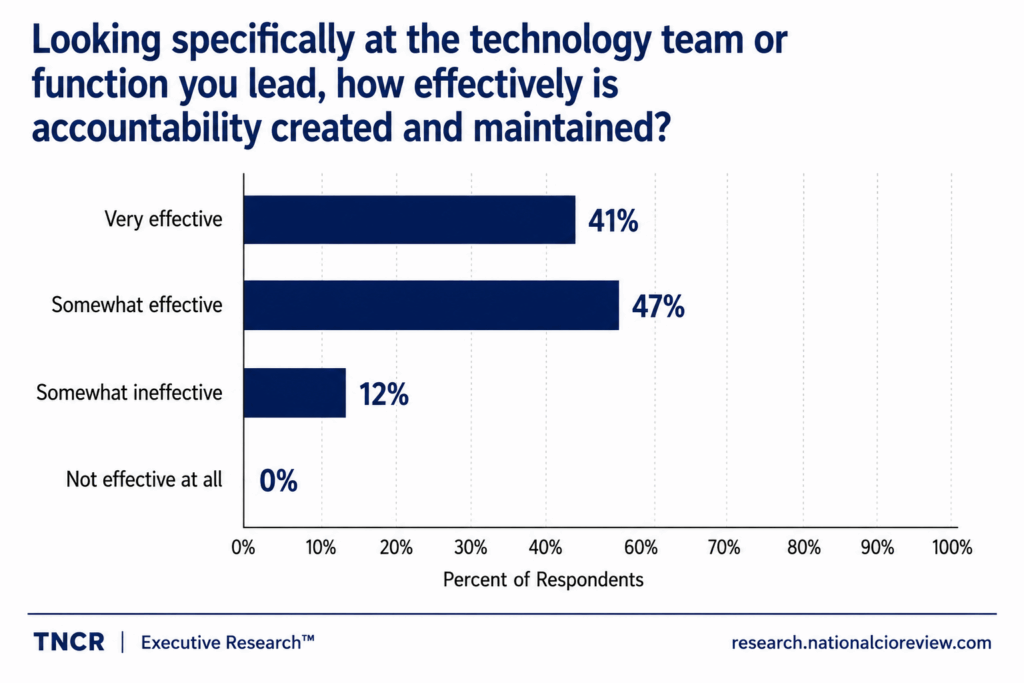
A combined 88% of respondents describe accountability within their technology team or function as very or somewhat effective with 41% self-rating as very effective. Only a small minority view it negatively, and none characterize it as not effective at all.
The strength of that response provides an important starting point. CIOs, CTOs, and CISOs operate in functions where responsibility is often highly visible. Technology organizations manage business-critical systems, cybersecurity, transformation initiatives, digital products, infrastructure, data, budgets, vendors, and day-to-day operations. Many of those responsibilities carry defined commitments and clear consequences when expectations are not met.
Accountability is also embedded in many of the mechanisms through which technology work is managed. Projects have owners. Incidents have escalation paths. Programs have milestones. Services are measured against performance expectations. Roadmaps establish commitments that can be reviewed against delivery.
That operating environment does not eliminate accountability challenges, but it provides structure around who owns an outcome, what is expected, and how progress is assessed.
“The single most important lesson in accountability is that you are no longer judged by what you accomplish, but by what your team delivers.”
Sankara Vishi Viswanathan, SVP and CIO at Day & Zimmermann
A Different View Across the Company
Asked to assess accountability across their companies overall, technology leaders offer a more measured assessment.
About two-thirds say leaders across their companies create and maintain accountability very or somewhat effectively, with only 12% assessing as very effective. Roughly one-third view company-wide accountability as somewhat ineffective or not effective at all.
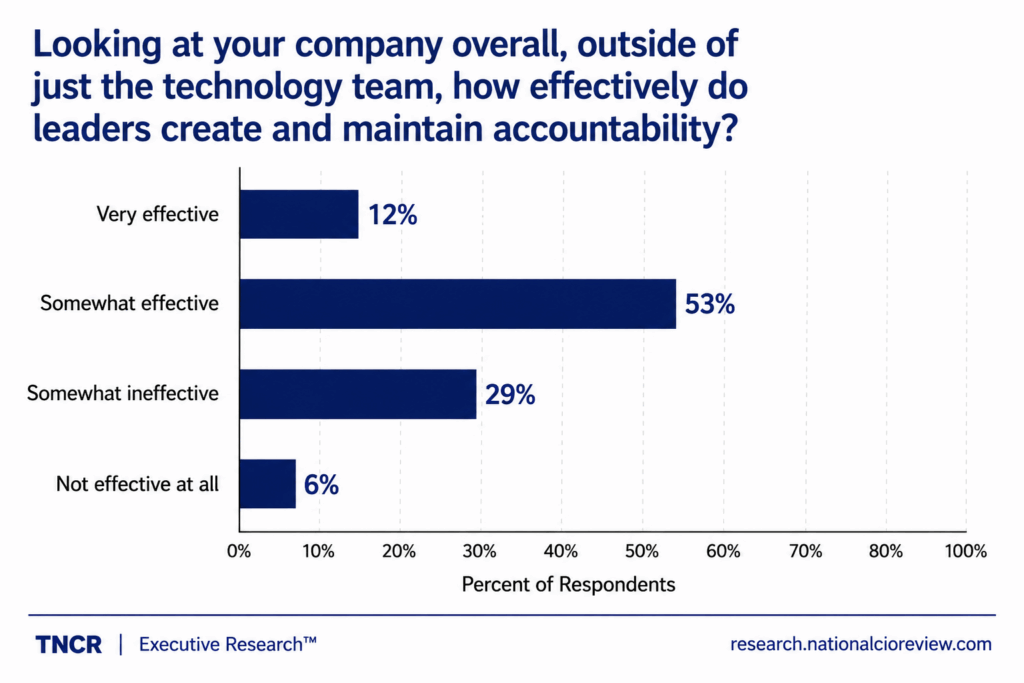
The significance is not simply that the company-wide results are lower. It is that the assessments come from the same executives.
These leaders participate in enterprise decision-making while directly overseeing technology organizations. They see how commitments are established and managed within their own functions, but they also experience how accountability operates when work crosses business units, leadership teams, and organizational boundaries.
From that broader vantage point, their confidence declines.
Enterprise accountability can involve a more complex web of dependencies. An outcome may require technology, finance, operations, human resources, legal, and business leadership to contribute at different stages. Decision authority may sit in one part of the organization while execution responsibility sits somewhere else. Priorities can differ across functions even when everyone is contributing to the same enterprise objective.
The TNCR findings bring that complexity into focus. Technology leaders largely believe accountability is being maintained within the functions they control most directly. Their view becomes less positive when accountability extends across the company.
Where Accountability Breaks Down
The company-wide findings provide more insight into where executives see that friction occurring.
Rather than identifying one overwhelming problem, respondents point to a collection of challenges. Inconsistent leadership follow-through, cultural resistance to accountability, unclear ownership, and competing or constantly changing priorities are among the leading concerns. Executives also identify unclear metrics and difficulty addressing underperformance as obstacles.
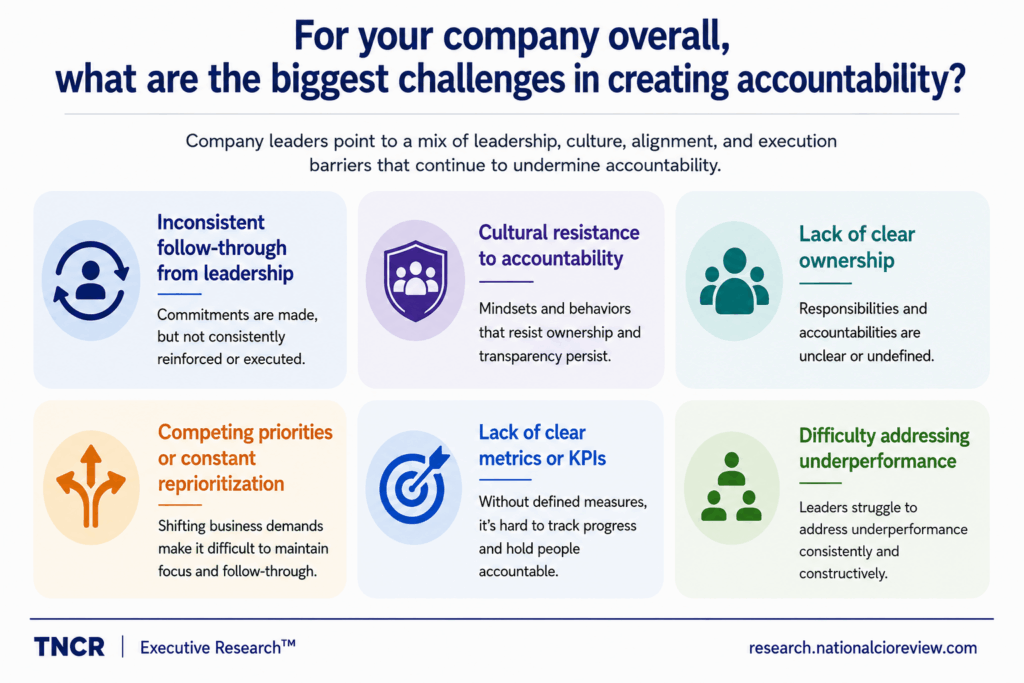
The range of responses is revealing because accountability depends on several organizational conditions working together.
Ownership establishes who is responsible. Priorities determine what deserves attention. Measurement makes progress visible. Leadership follow-through reinforces whether commitments continue to matter. Performance management determines how missed expectations are addressed.
Weakness in any one of those areas can make accountability harder to sustain.
Consider unclear ownership. When responsibility is spread among multiple functions or leaders, it can become difficult to determine who ultimately owns the outcome. Even when ownership is clear initially, shifting priorities can alter the resources, attention, and timelines available to fulfill the commitment.
Leadership consistency adds another dimension. Accountability depends not only on setting expectations but on following through after those expectations have been established. If commitments are emphasized in one situation and overlooked in another, the standard itself can become less clear.
Culture also matters. Accountability requires organizations to address missed commitments and underperformance directly. When those conversations are avoided or accountability is viewed primarily as punitive, maintaining consistent ownership can become more difficult.
Taken together, the findings show that enterprise accountability is not defined by a single point of failure. It is shaped by the interaction of leadership, culture, ownership, priorities, measurement, and performance management.
The Pressure of Shifting Priorities
Technology functions face accountability challenges of their own, but the pattern differs from the broader enterprise.
Competing priorities or constant reprioritization emerged as the leading challenge, ahead of talent and capability gaps, cultural resistance, and weak alignment between teams or stakeholders.
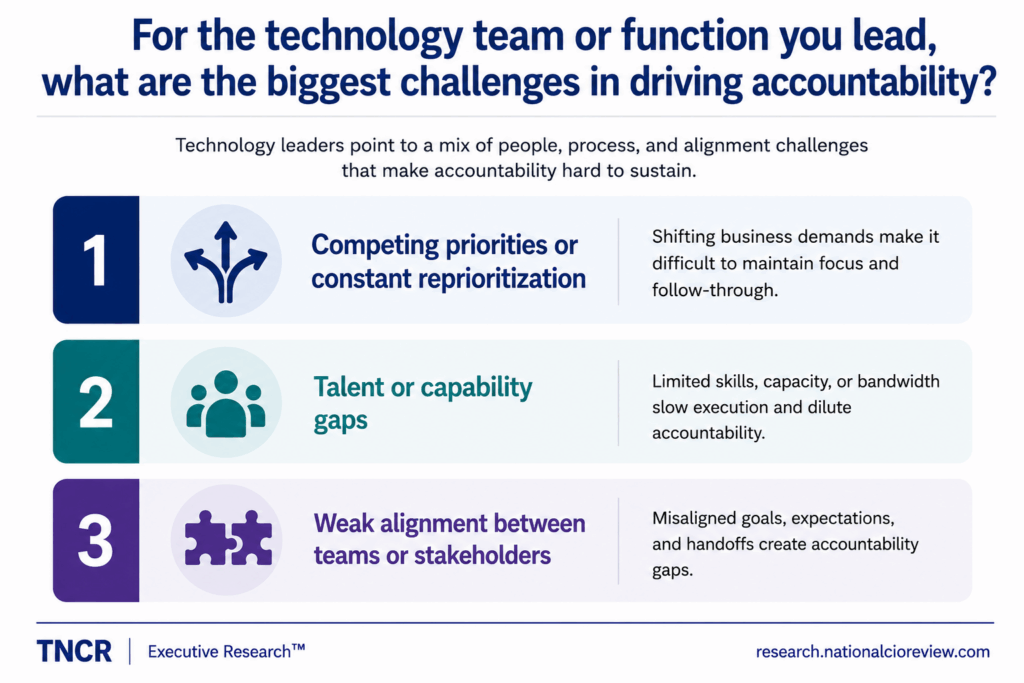
The prominence of reprioritization adds an important dimension to the strong confidence technology leaders express in their own functions. Even in environments where accountability is viewed favorably, maintaining it becomes more difficult when priorities are continually being reconsidered.
Technology organizations operate in conditions where that pressure can be persistent. Strategic initiatives compete with operational demands. Cybersecurity issues can require immediate attention. New business requirements can redirect resources. Regulatory needs can emerge unexpectedly. Transformation programs can collide with the day-to-day work required to keep the enterprise running.
Each change has implications for existing commitments.
The accountability challenge is therefore not limited to assigning an owner. Leaders also have to maintain clarity about what that owner remains responsible for when the surrounding priorities change.
Constant reprioritization can create tension between commitment and capacity. When new work rises in importance, existing work does not necessarily disappear. Teams can remain responsible for previously established outcomes while simultaneously being asked to redirect attention elsewhere.
That makes prioritization part of the accountability environment itself. Clear ownership matters, but so does continued alignment around which commitments take precedence as circumstances change.

Ownership Comes First
TNCR asked participating executives to share the most important advice they would give an up-and-coming leader about accountability. Their responses provide a leadership perspective on what accountability requires in practice.
Ownership emerged as a recurring theme, beginning with the leader.
“You cannot hold your people accountable until you accept your role in their failures,” said Shaun Robles, CTO/CISO at Waterfront Logistics.
That perspective expands the traditional view of accountability. Leaders are responsible not only for evaluating outcomes but also for examining the environment surrounding them. Expectations, resources, priorities, communication, and support all shape the conditions under which people are expected to deliver.
“Accept your responsibilities and always ensure you take accountability for you and your team. If this is not done first, you can’t expect to hold others to accountable.”
Dharmesh Patel, Vice President at Centric Infrastructure Group
A similar emphasis appears in the advice from Paul Mohabir, Head of Technology at Transervice Logistics, who stressed taking responsibility for outcomes, communicating transparently, and addressing problems early rather than assigning blame.
Kiran Palla, Chief Information Officer at CogniwareAI focused on owning outcomes rather than simply effort. His guidance also emphasized setting clear expectations, following up consistently, acknowledging mistakes, and maintaining a focus on solutions.
Prioritization surfaced here as well. Harsha Bellur, Chief Information Officer at James Avery Jewelry, advised emerging leaders to focus on prioritization and communicate capacity. His guidance connects accountability to the practical realities leaders face when deciding what their teams can reasonably commit to delivering.
Across these responses, accountability is not presented simply as a mechanism for holding someone else responsible. It begins with leaders establishing credible commitments and accepting responsibility for their own role in the outcome.
Clarity Sets the Standard
If ownership establishes responsibility, clarity defines what that responsibility actually means.
Several contributors emphasized that accountability becomes difficult when expectations are ambiguous.
Raj Murthy, Chief Technology Officer at George Mason University, framed the issue around clarity in expectations, outcomes, and timelines, concluding, “You cannot expect accountability without it.”
That distinction is important. Assigning an owner is only the beginning. People also need to understand what outcome they are expected to deliver, when it is expected, and how success will be evaluated.
Measurement provides another part of that foundation. Lyman Mubukani, Technology Lead at Right to Care, emphasized giving teams clear metrics or KPIs.
Said Toro, Technology Operating Partner at Strategic Resource Technologies, added another dimension by emphasizing documentation, realistic expectations, and the need to understand the factors that determine whether delegated work can actually be accomplished.
“As a leader, your responsibility is to ensure the team has a clear understanding of the vision, purpose, and business outcomes behind the work. When teams understand why the work matters, how their role contributes, and how success is measured, accountability becomes intrinsic, not enforced.”
Shiva Rudroju, Senior Director at OmniCable
Taken together, the advice describes accountability as something that has to be established before performance can be judged. Responsibility without clarity leaves too much room for different interpretations of what was promised, what was possible, and what constituted success.
Effective accountability therefore begins well before a deadline is missed. It starts when leaders define the commitment.
Turning Commitments Into Action
Clarity establishes the expectation, but accountability ultimately depends on what happens after the commitment is made.
Some of the executive advice focused on surprisingly simple operating disciplines.
Lonnie Snyder, Chief Technology and Information Officer for the 2026 Special Olympics USA Games, recommended ending meetings by capturing the next action and identifying who owns it.
That practice addresses a common gap between agreement and execution. Meetings can end with broad alignment about what needs to happen while leaving the next step, owner, or timeline unclear.
Making ownership explicit changes the nature of the commitment.
The person responsible knows what is expected. Other participants know who owns the next action. Follow-up has a clear starting point. Responsibility is less likely to become blurred as the conversation recedes.
The principle scales beyond meetings. Projects, decisions, programs, incidents, and strategic initiatives all benefit from visible ownership. Accountability becomes easier to sustain when commitments can be traced from decision to owner to outcome.
Follow-through is what keeps that chain intact.
“Find an accountability partner that is either impacted by or is an influence to the achievement of your goals and strategy.”
Lou Trebino, (Former) Audit Chief Technology Officer at KPMG
The Trust Consequence
For several contributors, accountability also extends beyond execution to leadership credibility.
“Failing to take accountability erodes trust in you as a leader,” said Lonnie Garris, Cybersecurity Consultant at Riomar Group.
That observation highlights a tension leaders face when outcomes fall short. Accountability requires responsibility, but organizations can undermine that responsibility when every mistake is treated primarily as an opportunity to assign blame.
Leaders set the tone through their own response to failure. Teams observe whether leaders acknowledge mistakes, whether expectations are applied consistently, and whether responsibility travels upward as readily as it travels downward.
Sankara Vishi Viswanathan encouraged leaders to examine their own role when results fall short, including whether teams had the necessary tools, context, authority, and support.
That does not remove responsibility from the individual or team accountable for an outcome. It broadens the examination of what contributed to the result.
Trust becomes important because sustainable accountability depends on people being willing to surface problems rather than hide them. Leaders need visibility into risks, missed expectations, and changing conditions early enough to respond.
Accountability loses much of its value if people only acknowledge problems after they can no longer be corrected.
Closing the Accountability Gap
Ownership needs to be explicit. Expectations need to be clear. Commitments need to reflect actual priorities and capacity. Progress needs to be visible. Follow-through needs to be consistent. Leaders need to examine their own responsibility alongside the responsibility they expect from others.
These are not isolated practices. They reinforce one another.
Clear ownership has limited value when priorities continually change without resetting expectations. Metrics matter less when leaders do not follow through on what they reveal. Commitments lose credibility when teams are assigned more priorities than their capacity can support. Accountability becomes harder to sustain when leaders expect standards from others that they do not demonstrate themselves.
That interconnectedness may be one of the most important insights to emerge from the research. Accountability is not a single management action. It is an operating discipline that has to remain intact from expectation through execution.
The Wrap
The latest TNCR | Executive Research findings show a clear difference in how technology leaders assess accountability inside the functions they lead and across the broader enterprise.
Within technology, confidence is high. Across the company, it is more qualified. The barriers respondents identify help explain why accountability becomes harder to sustain as work crosses functions and priorities compete for attention.
For executive leaders, the more consequential question is not whether accountability matters. It is whether the organization has created enough clarity around ownership, priorities, expectations, and follow-through for accountability to survive the complexity of enterprise execution.
Accountability is strongest when responsibility remains visible, expectations remain credible, and leaders reinforce both consistently.
About TNCR | Executive Research
TNCR | Executive Research is a peer-driven research platform from The National CIO Review that captures timely perspectives from CIOs, technology executives, and digital leaders on the issues shaping enterprise technology. Each research initiative combines quantitative insights with practitioner commentary to help leaders benchmark priorities, understand emerging risks, and make more informed decisions.
The platform is designed to elevate the voices of technology leaders while providing the broader executive community with actionable insights grounded in real-world experience.
Become a Contributor: https://research.nationalcioreview.com/