
CIOs and technology leaders find themselves in the trenches of year-end planning and 2026 forecasting. While innovation continues, the signs from within the tech leadership community point to a challenging road ahead.
To better understand what challenges may shake IT strategies in the coming year, The National CIO Review conducted a community poll asking:
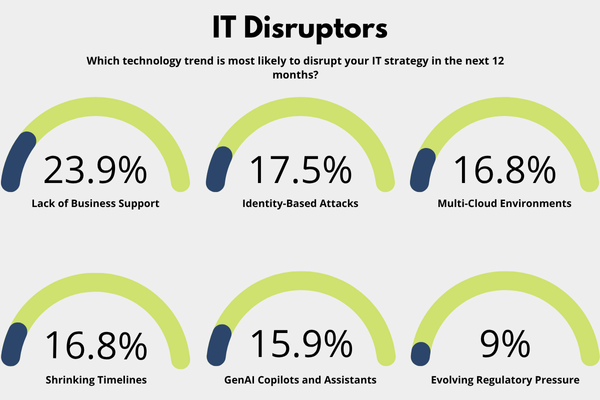
“Which technology trend is most likely to disrupt your IT strategy in the next 12 months?”
The responses revealed a surprising result.
While it could have been anticipated that artificial intelligence or cybersecurity threats to top the list, the most selected disruptor was Lack of Business Support. For many leaders, the technology itself is not the issue. Rather, the internal alignment around it poses the greatest threat to forward momentum.
Lack of Business Support (23.9%)
Leading the poll with 23.9%, Lack of Business Support stands out as the top concern among IT leaders. While many organizations continue to invest in digital initiatives, those efforts often stall when executive buy-in is missing or departmental alignment breaks down.
Whether it’s unclear priorities or underfunded projects, technology efforts falter without strong cross-functional collaboration.
CIOs are recognizing that success relies as much on relationships as it does on architecture or infrastructure.
To address this challenge, tech leaders are leaning further into business partnership; translating outcomes, building trust, and ensuring that every initiative has a shared purpose beyond the IT department.
Identity-Based Attacks (17.5%)
Ranking second with 17.5%, identity-based attacks remain a primary disruption heading into 2026.
Malicious impersonation tactics continue to transform, making identity the most frequently exploited entry point for attackers.
As the workforce becomes more distributed and systems more connected, organizations are increasing investments in measures like multi-factor authentication and real-time behavioral monitoring.
For CIOs, the focus is on keeping defenses current. The sophistication of attackers is growing, and responses must keep pace.
Multi-Cloud Environments (16.8%)
Receiving 16.8% of the vote, multi-cloud environments are clearly on the minds of technology leaders.
Initially implemented to boost flexibility and avoid vendor lock-in, many organizations now face the reality of managing inconsistent tools and overlapping capabilities on top of ballooning costs.
Gaining visibility across platforms like AWS and Azure has become more difficult than anticipated.
CIOs are working to untangle their cloud footprints by consolidating workloads and accountability within their systems.
What was once a value play has become a call for simplification.

Shrinking Timelines (16.8%)
Also accounting for 16.8% of the vote, shrinking timelines are creating delivery challenges across the enterprise.
AI adoption and the pressure to deliver new features faster are straining development teams.
While speed is crucial, rushing projects without adequate testing or planning opens the door to reliability issues and team burnout.
For CIOs, the task is balancing speed with stability and protecting team bandwidth without slowing innovation.
Delivery pipelines, DevOps, and clearer product ownership will all play a role in helping teams meet these tighter timelines with confidence.
GenAI Copilots and Assistants (15.9%)
Despite being a headline story across the industry, GenAI Copilots received 15.9% of the vote.
Tools ranging from Microsoft Copilot to ChatGPT Enterprise are changing how work gets done, but they also bring governance and user adoption concerns.
Many leaders appear to be aware of these issues and are tackling them proactively, which may explain GenAI’s middle-tier ranking.
Rather than being dismissed, GenAI is likely being integrated thoughtfully by targeting rollouts where it’s most valuable, with appropriate oversight.
Evolving Regulatory Pressure (9.0%)
Earning 9.0% of the total vote, evolving regulatory pressure was ranked lowest in this poll.
While data privacy laws and AI-related regulations are increasing globally, many respondents seem to view these as known issues that are important but manageable.
That said, compliance continues to affect every system and tool CIOs deploy. Whether the EU’s AI Act or various U.S. state-level laws, regulatory frameworks are expanding quickly.
Organizations that treat compliance as a last step risk costly delays or forced rework.
CIOs who are building with foresight now will be better prepared to adapt.
The Wrap
This year’s poll makes it clear that technology isn’t the only disruptor on the CIO radar; leadership and communication matter just as much.
Data points to a need for greater connection between IT and the rest of the enterprise.
Heading into 2026, successful CIOs will focus on:
- Building stronger collaboration across the executive team
- Keeping identity protections up to date as threats evolve
- Simplifying cloud operations to improve performance and control
- Equipping teams to deliver faster without cutting corners
- Deploying GenAI with discipline and clear use cases
- Proactively preparing for the next wave of regulations
Disruption is just as much about how teams and priorities respond when plans get tested as it is about the next technology trend.