
What do Gartner’s top 10 strategic technology trends for 2027 have in common with a three-course meal? According to Distinguished VP Analyst Gene Alvarez, quite a bit.
Speaking at Gartner IT Symposium/Xpo 2026 in Orlando, Alvarez compared this year’s list to a tasting menu. Some offerings will leave you wanting more, while others may not be to your taste. For CIOs, the question is which technologies make sense for their organizations and when.
This year’s trends fall into three categories, with adoption horizons ranging from one to more than five years.
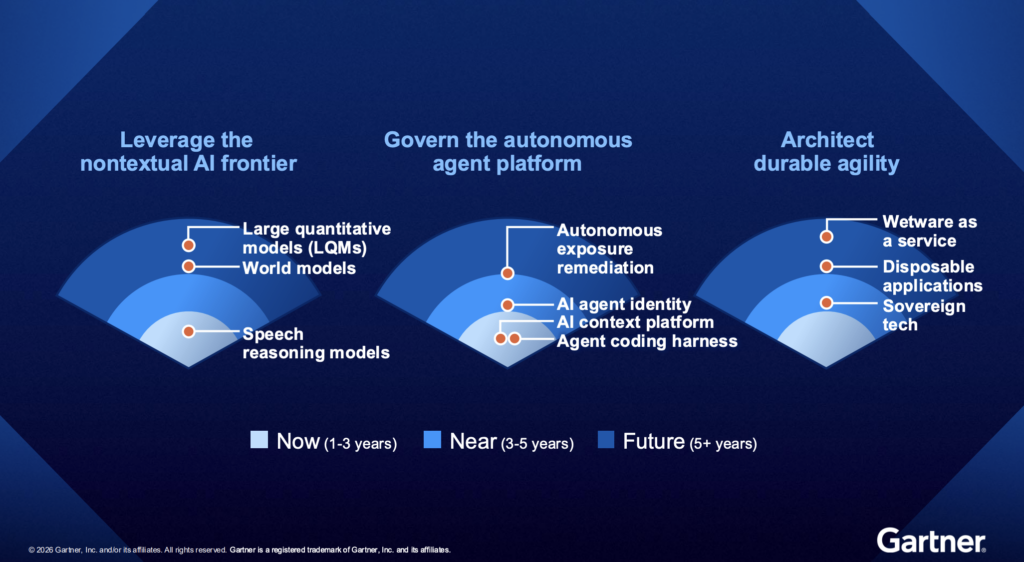
Source: Gartner, October 2026.
AI Moves Beyond Language Models
Gartner’s first three trends focus on AI capabilities beyond text-based applications, from quantitative analysis to real-world simulation.
Large quantitative models (LQMs) are designed for complex mathematical analysis. Alvarez compared asking a traditional LLM to solve mathematical problems to “asking an English major to talk about calculus.” LQMs could offer greater reliability for forecasting and other data-intensive decisions.
Speech reasoning models process audio directly, interpreting tone and conversational context without relying solely on transcription. Alvarez pointed to customer service as a key application, recommending that organizations begin with lower-risk interactions as the technology matures.
World models allow organizations to simulate scenarios and anticipate potential outcomes. Alvarez used supply chain disruptions as an example, suggesting CIOs test these models against historical events with known results before broader adoption.
“When you ask an LLM for an answer about math, you are asking an English major to talk about calculus.”
Gene Alvarez
Governing Autonomous Agents
Gartner’s next four trends focus on managing AI agents as they take on more complex workflows.
AI context platforms help agents operate within an organization’s policies and processes. Gartner predicts that by 2027, organizations prioritizing semantics in AI-ready data could improve agentic AI accuracy by up to 80% and reduce costs by up to 60%. Interoperability is another consideration as vendors introduce competing platforms.
Agent coding harnesses provide oversight throughout the software development lifecycle, helping coding agents follow organizational standards. Alvarez described these systems as evolving assets that can incorporate institutional knowledge and become more effective over time.
AI agent identity addresses the risks of unmanaged agent privileges. By 2028, Gartner predicts that 25% of enterprise security breaches will trace back to AI agent abuse, highlighting the importance of unique identities and dynamic access controls.
Autonomous exposure remediation uses AI and automation to identify and resolve vulnerabilities across enterprise systems. With AI accelerating software development, Gartner recommends measuring the effectiveness of remediation rather than simply the number of vulnerabilities addressed.

Rethinking Enterprise Architecture
Gartner’s final three trends explore changing approaches to technology dependencies and application lifecycles, along with emerging alternatives to traditional computing.
Sovereign technology extends beyond data residency to address dependencies across the entire technology stack. Gartner predicts that by 2030, more than 75% of organizations outside the U.S. will adopt digital sovereignty strategies. Alvarez stressed the importance of realistic vendor exit strategies, noting that older, more portable technologies may sometimes offer greater flexibility than the latest alternatives.
Disposable applications are designed with retirement in mind, allowing organizations to decommission software once its business purpose is fulfilled. Alvarez used merger-specific applications as an example, where software could be retired once the integration is complete rather than becoming another permanent system to maintain.
Wetware as a service explores using biological computing systems as a potentially more energy-efficient alternative to silicon-based infrastructure. Gartner expects the technology to take several more years to mature, with questions around bioethics and intellectual property ownership among the considerations for future adoption.
The Wrap
Gartner’s 2027 trends put an interesting emphasis on the architecture surrounding AI, particularly as autonomous systems become more capable.
Some of these technologies are already finding their way into enterprise environments, while others remain largely experimental.
Not every trend will suit every organization’s appetite.
Knowing which technologies to pursue, and which to leave on the menu for now, may be just as important as the technology itself.