Enterprise technology organizations are not short on priorities.
AI has moved from experimentation into operational use. Cybersecurity demands continue to evolve. Modernization remains active across the enterprise, even as CIOs are expected to improve data capabilities, manage risk, and keep existing environments running.
The latest TNCR | Executive Research™ examines that reality through the lens of talent and operating models. In our TNCR CxO Checkpoint, CIOs, CTOs, CISOs, and other senior technology leaders identified the capabilities that are hardest to build or retain, assessed where leadership development is falling behind, described how major technology decisions are made, and shared the workforce concerns occupying their attention.
The findings resist a simple story about skills shortages. Specialized expertise remains difficult to secure, but executives are also confronting questions about leadership, organizational structure, existing knowledge, and how effectively people can navigate change.
For CIOs, those issues increasingly sit alongside the technology itself.
Change Leadership Moves to the Foreground
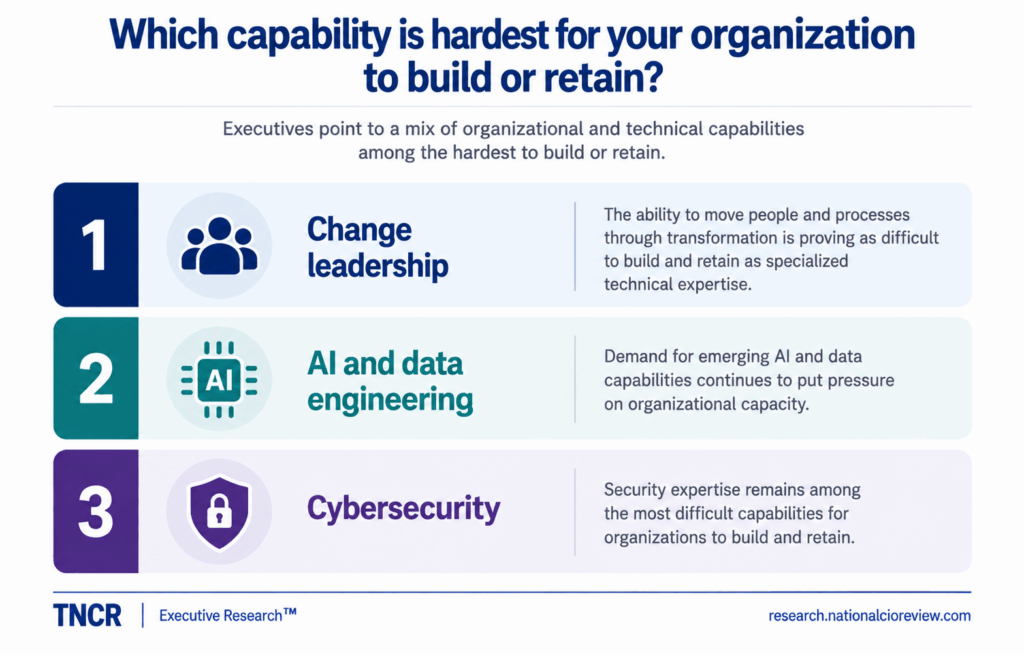
Asked which capability is hardest for their organization to build or retain, 26% of respondents selected change leadership, narrowly ahead of AI and data engineering and cybersecurity, each at 23%. Legacy systems expertise followed at 10%. Enterprise architecture and cloud platform engineering each accounted for 6%, while product, project, and program management and vendor and commercial management each registered at 3%.
The margins are small, so the finding should not be read as evidence that change leadership has somehow displaced technical scarcity. AI, data, and cybersecurity remain prominent concerns.
What is striking is that change leadership now sits in their company.
Technology initiatives increasingly reach into the way work gets done. AI can change roles, workflows, and decisions. Modernization can alter processes that have been embedded in the business for years. Cybersecurity programs can introduce new responsibilities far beyond the security organization.
Building the technology is one part of that work. Moving an organization with it is another.
For Rocky Vienna, Managing Director at Vienna Technology Group, the concern is uncomplicated. Asked about the talent or leadership gap that worries him most for the year ahead, he answered: “Change Management.”
AI Fluency Is No Longer Optional
The leadership findings introduce a different challenge.
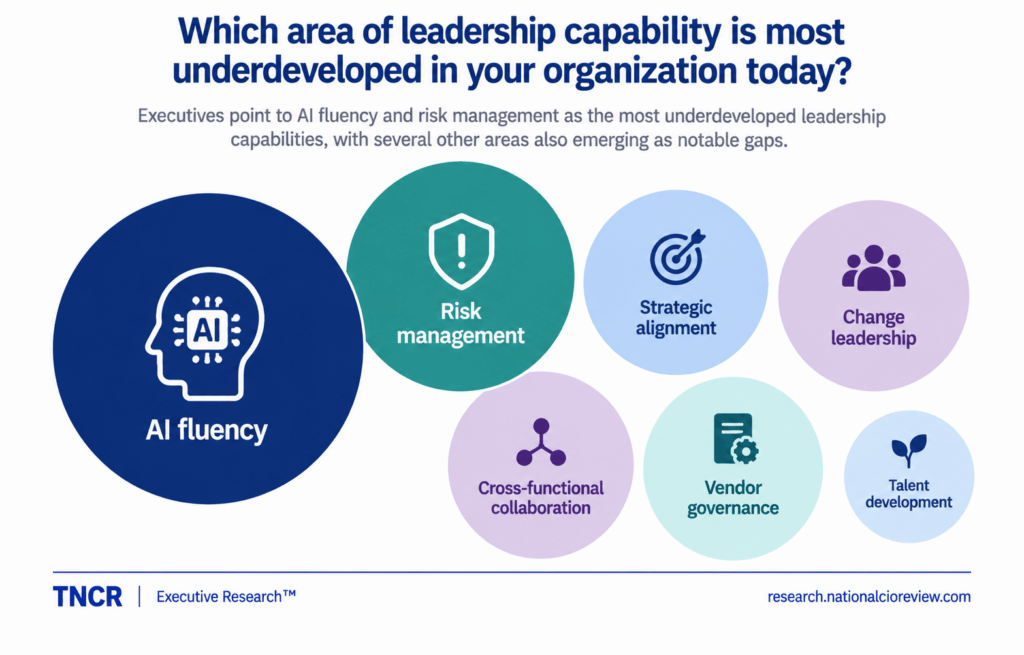
AI fluency is the most frequently identified underdeveloped leadership capability at 20%. Risk management follows at 17%. Strategic alignment, change leadership, cross-functional collaboration, and vendor governance each account for 13%, while talent development registers at 10%.
No single category dominates the responses. That breadth is itself revealing. The leadership requirements surrounding technology are becoming more varied at the same time that AI is adding an entirely new area of executive fluency.
For a CIO, AI fluency does not mean turning every executive into an engineer. It means creating enough understanding across leadership to make informed choices about where AI belongs, what value is realistic, which risks require intervention, and how governance should evolve as adoption expands.
Paul Mohabir, Head of IT at Transervice Logistics, sees a gap developing between those responsibilities and leadership preparedness. His concern is “the growing gap between technical acceleration and leadership readiness.” He points to organizations adopting AI and automation faster than they are developing leaders prepared to manage the resulting change, governance, risk, and workforce trust.
That creates an unusual development challenge. The technology may advance faster than the leadership experience surrounding it.
AI expertise can be recruited. Executive fluency has to spread much more broadly.
Hiring Is Only Part of the Problem
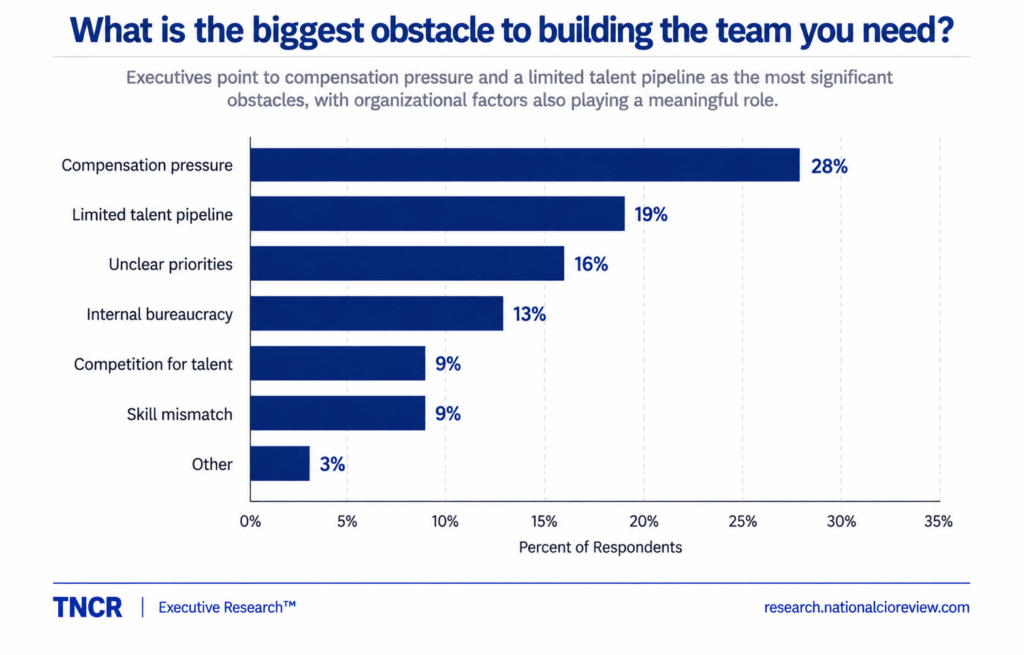
The external labor market still matters, and compensation leads the list of obstacles executives encounter when building their teams.
Twenty-eight percent cite compensation pressure, followed by a limited talent pipeline at 19%. Competition for talent accounts for another 9%.
For Lonnie Garris, the cybersecurity shortage is fundamentally about supply:
“It’s a sheer numbers problem. There are not enough qualified IT/Cyber professionals to handle the day-to-day functions and regulatory certifications.”
Lonnie Garris, Cybersecurity Consultant at Riomar Group
But the same question surfaces a different kind of constraint. Unclear priorities account for 16% of responses and internal bureaucracy for 13%, while skill mismatch represents another 9%.
These are not recruiting problems.
A limited talent pipeline may require a different sourcing strategy. Compensation pressure may require difficult choices about where the organization is willing to pay a premium. Unclear priorities are different because they affect the organization’s ability to determine where scarce people should be deployed in the first place.
That distinction becomes increasingly important when every capability cannot be funded equally. CIOs have to make choices about where expertise needs to be deepest, what can be developed internally, and where external partners can provide leverage.
New Capabilities, Old Dependencies
The attention surrounding AI can make workforce planning appear more forward-looking than it really is. For many CIOs, some of the most consequential capability decisions involve technologies the organization eventually hopes to leave behind.
Said Toro, Former CIO and Operating Partner at Hidden Harbor Capital Partners, now with Strategic Resource Technologies describes the concern directly:
“Legacy systems and ERP systems are my gap issues at this time. Finding the right talent to manage aging systems will be an issue. Unfortunately, it is something that will be required at least for the next 2-3 years.”
Legacy systems expertise accounts for 10% of responses to the question about the hardest capability to build or retain. Scott Kelly, Technology & Digital Transformation Leader at Office Pride Commerical Cleaning Services separately points to “Legacy end-user skill sets” as his concern for the year ahead.
The tension is easy to overlook.
Technology organizations rarely move cleanly from one generation of capability to another. They overlap. AI and data expertise may need to grow while ERP knowledge is preserved. Cloud adoption progresses while older applications remain operational. Cybersecurity teams have to protect both.
That changes the economics of workforce planning. CIOs are not simply deciding what skills they will need next. They are also deciding how long they need the skills associated with what came before.
Sometimes the expertise attached to a technology the enterprise eventually intends to retire becomes more valuable precisely because fewer people still possess it.
Where Technology Decisions Sit
The operating-model findings shift the research from who does the work to how consequential decisions are structured.
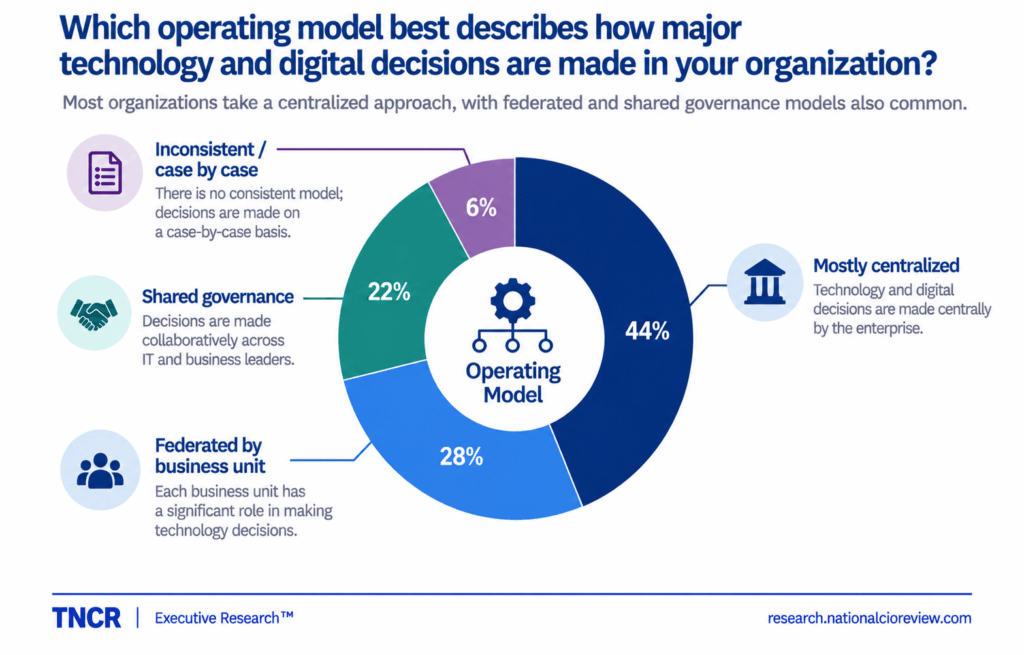
Forty-four percent of respondents say major technology and digital decisions are mostly centralized. Another 28% operate in a federated model by business unit, while 22% use shared governance. Six percent describe decision-making as inconsistent and case by case.
There is no basis in the findings for declaring one approach superior. Different organizations require different balances between enterprise consistency and local autonomy.
What has changed is the range of interests many technology decisions now touch.
An AI initiative may require technology, data, legal, risk, HR, finance, and business leaders to weigh in. A modernization program can force decisions about processes as well as platforms. Cybersecurity can introduce requirements that affect nearly every employee.
For CIOs, the practical question becomes whether existing decision structures are suited to that level of participation.
A centralized organization approaches those intersections differently from a federated one. Shared governance introduces another set of dynamics. The right model is contextual, but the growing reach of technology means the consequences of those choices extend further across the enterprise.
The Growing Pressure on Decision Speed
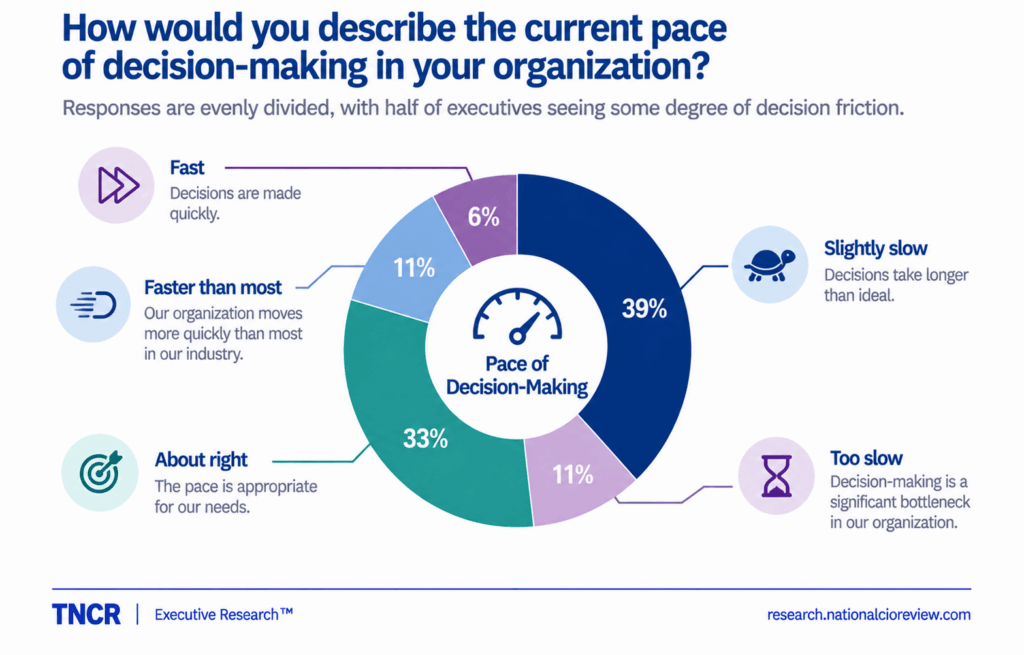
When respondents were asked about the current pace of organizational decision-making, the answers were almost evenly divided.
Thirty-nine percent describe the pace as slightly slow and another 11% as too slow. Thirty-three percent say it is about right. Eleven percent characterize their organizations as faster than most, while 6% say decision-making is fast.
Speed alone is not a measure of good governance. A major architecture choice, AI policy, or cybersecurity investment may deserve significant deliberation.
Still, there is a difference between deliberate and stuck.
That distinction becomes harder to manage when the environment surrounding the decision is moving. AI capabilities change. Vendor propositions evolve. Regulatory expectations develop. Business needs shift.
Matt Rider, Former SVP and CIO for Home Lending Technology at Wells Fargo captures the leadership requirement succinctly:
“Leaders must be able to operate inside ambiguity and still drive disciplined execution.”
Matt Rider, Founder & Operating Partner at Lumerai Advisors
The objective is not perpetual acceleration. It is knowing when further deliberation will materially improve a decision and when the organization has enough information to move.
For CIOs, that makes decision effectiveness partly a question of structure and partly a question of leadership judgment.
CIOs Want an Outside View
One of the strongest points of agreement in the research concerns outside perspective.
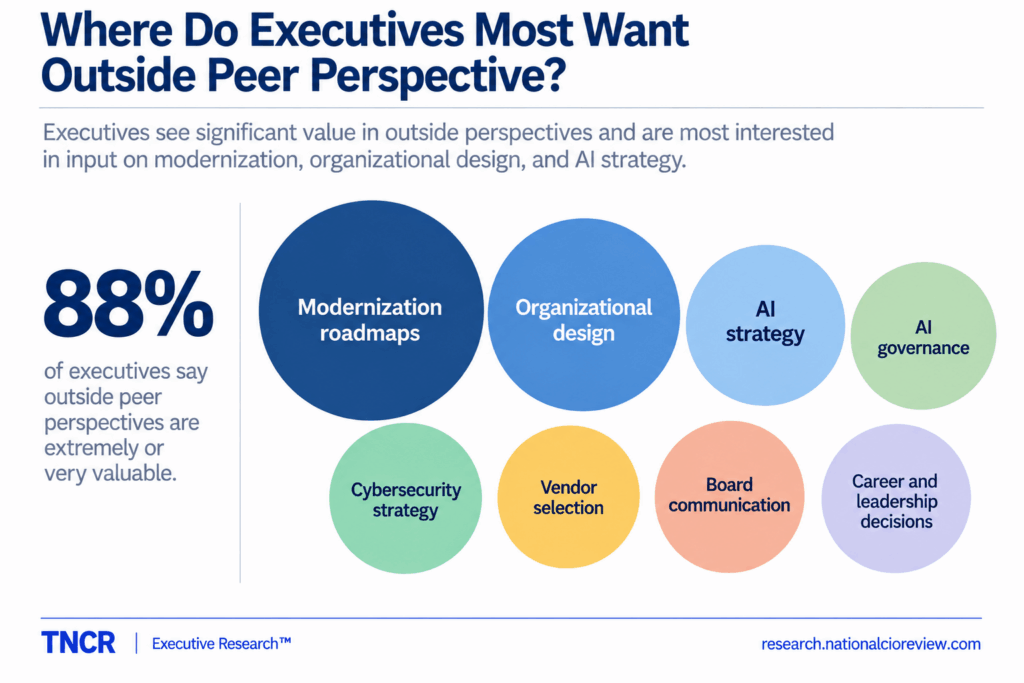
When executives were asked how valuable outside peer perspectives are when making major decisions, 44% said extremely valuable and another 44% said very valuable. The remaining 11% described them as moderately valuable.
Where executives want that perspective is equally interesting.
Modernization roadmaps lead at 21%, followed closely by organizational design at 19%. AI strategy and AI governance each account for 13%, cybersecurity strategy for 10%, and vendor selection, board communication, and career and leadership decisions each register at 8%.
A modernization roadmap depends on the existing estate, investment capacity, business priorities, risk tolerance, and appetite for disruption. Organizational design is similarly contextual. A structure that helps one enterprise move more effectively may introduce unnecessary complexity in another.
That is precisely why experience elsewhere can be useful.
Peer perspective offers a view into decisions after they leave the strategy deck and encounter the realities of implementation. What tradeoffs emerged? What proved harder than anticipated? Which organizational choices mattered most?
For CIOs navigating decisions without universally established playbooks, those reference points can be particularly valuable.
Transformation Is Outpacing Leadership Readiness
Kiran Palla, Chief Information Officer at CogniwareAI, offers a phrase that captures much of the tension running through the findings: “leadership capacity under transformational strain.”
His concern is not confined to AI.
Palla points to AI acceleration alongside quantum risk, cybersecurity escalation, regulatory shifts, and geopolitical instability. The challenge, in his view, is finding leaders capable of integrating those forces into coherent strategy rather than treating each as an independent agenda.
He describes the requirement as “strategic technical fluency,” connecting AI, cybersecurity, data governance, sustainability, and business outcomes. He also raises the issue of change-leadership stamina as executives guide teams through sustained ambiguity.
“Overall, we have more transformation than leaders equipped to lead transformation.”
Kiran Palla, Chief Information Officer at CogniwareAI,
By this point, that argument has been building throughout the findings.
Change leadership sits alongside AI/data engineering and cybersecurity among the capabilities respondents find hardest to build or retain. AI fluency leads the list of underdeveloped leadership capabilities, but it is surrounded by concerns ranging from risk management to strategic alignment. Legacy expertise remains necessary even as new skills are added. The obstacles to assembling teams include both labor-market pressures and conditions inside the organization.
The operating-model findings broaden the picture further. CIOs are not simply assembling capabilities. They are working within different structures for making decisions about where those capabilities should be applied.
That is where talent and operating model meet.
The Wrap
The technology agenda is not getting smaller. AI will create new opportunities. Cybersecurity will continue to demand attention. Modernization will remain unfinished in many enterprises, even as the next generation of capabilities arrives.
The harder question is whether the enterprise around that technology can evolve at the same pace.
That puts a different kind of responsibility on the CIO. Building the next technology capability matters, but so does developing leaders who can navigate its consequences, preserving expertise the enterprise still depends on, and creating decision structures that allow the organization to act when the path forward is not entirely clear.
The findings suggest that those challenges are increasingly intertwined. Talent decisions affect execution. Leadership capability shapes how effectively change is absorbed. Operating models influence how decisions move through the enterprise. None can be treated entirely in isolation.
The challenge for CIOs is to look beyond the technology roadmap and ask whether the enterprise is evolving alongside it. Where is leadership capacity falling behind? Which expertise cannot afford to disappear? Where do structures or decision processes make execution harder than it needs to be? And as AI and other capabilities advance, is the enterprise becoming better equipped to absorb change, or simply accumulating more technology?
The next test of CIO leadership may be less about what technology they bring into the enterprise and more about how effectively they help the enterprise change around it.
About TNCR | Executive Research
TNCR | Executive Research is a peer-driven research platform from The National CIO Review that captures timely perspectives from CIOs, technology executives, and digital leaders on the issues shaping enterprise technology. Each research initiative combines quantitative insights with practitioner commentary to help leaders benchmark priorities, understand emerging risks, and make more informed decisions.
The platform is designed to elevate the voices of technology leaders while providing the broader executive community with actionable insights grounded in real-world experience.
We use analytics and similar technologies to help us understand how people ineract with The National CIO Review, improve our services, and measure the effectiveness of our outreach. You can accept, decline, or manage your choices. Your choice is saved on this device. See our Privacy Policy.
Strictly Necessary
Always active
Required for the site to work (sign-in, security, and your saved preferences). Always on.
Preferences
The technical storage or access is necessary for the legitimate purpose of storing preferences that are not requested by the subscriber or user.
Analytics
Helps us understand how people use The National CIO Review and improve our services.The technical storage or access that is used exclusively for anonymous statistical purposes. Without a subpoena, voluntary compliance on the part of your Internet Service Provider, or additional records from a third party, information stored or retrieved for this purpose alone cannot usually be used to identify you.
Marketing
Helps us measure the effectiveness of our outreach and communications.
We use analytics and similar technologies to help us understand how people interact with The National CIO Review, improve our services, and measure the effectiveness of our content. You can review your privacy choices at any time. Your choice is saved on this device. See our Privacy Policy.
Strictly Necessary
Always active
Required for the site to work (sign-in, security, and your saved preferences). Always on.
Preferences
The technical storage or access is necessary for the legitimate purpose of storing preferences that are not requested by the subscriber or user.
Analytics
Helps us understand how people use The National CIO Review and improve our services.The technical storage or access that is used exclusively for anonymous statistical purposes. Without a subpoena, voluntary compliance on the part of your Internet Service Provider, or additional records from a third party, information stored or retrieved for this purpose alone cannot usually be used to identify you.
Marketing
Helps us measure the effectiveness of our outreach and communications.